Low-angle view across a lawn with pine straw in the foreground toward a single-story brick house with a dark shingled roof and covered porch, beside a large moss-draped oak and pine trees under an overcast sky.

Heat Pump Repair in Meridian, MS

Tell us about the job

Takes about a minute. No obligation.

RepairHeat PumpLauderdale County, MS
Step 1 of 2

What ZIP code is the job in?

The age of the compressor is what decides this

A heat pump that won't hold its charge or trips its breaker again and again is usually telling you the compressor is wearing out. Once that part is failing, repairs tend to be temporary fixes on a system that's closing in on the end of its life. A bad capacitor or a stuck reversing valve is a different story. Those are single parts doing one job, and swapping them brings the whole system back to normal.

A system that short cycles is working against itself

If the outdoor unit kicks on and off in short bursts instead of running a full cycle, something is making it shut down early, often a sensor reading wrong or airflow that's restricted. Left alone, that stop-start pattern puts more wear on the compressor than steady running ever would. Getting it looked at before a hot or cold stretch matters more than getting it looked at before anything else fails.

5 months
November through March, your system heats
5 months
May through September, it cools
37°F
the average winter night it heats against
90°F
the average summer afternoon it cools against
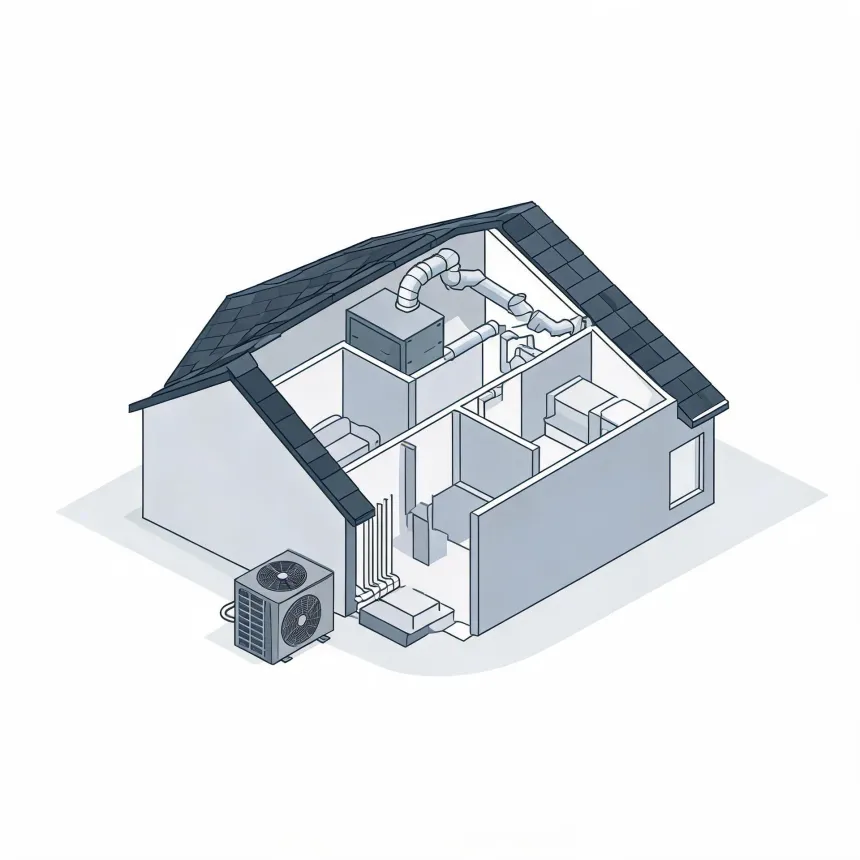
Isometric line illustration of a cutaway house showing interior rooms, an air handler with ductwork in the attic space, and an outdoor condenser unit beside the exterior wall.
Your system heats November through March and cools May through September.

NOAA nClimDiv, 1991–2020 normals

Half the homes in Lauderdale County were built in 1979 or earlier, half later.

A heat pump's age comes from when it was installed, not when the house was built, so check the unit's nameplate.

October is worth marking on the calendar. Heat here doesn't start until November, but that's exactly when a weak part gets found out, not before. A heat pump that's been limping along in standby all summer can seem fine right up until it has to switch over and carry the heat load for the first time. If a reversing valve is starting to stick or a sensor has been reading wrong, the first cold snap is when it shows. Getting a system looked at in October means any repair happens before the house actually needs the heat, not during the first week it does.

Get the usual fix

Nothing about this area is especially hard on it. It's most likely the usual problem with the usual fix.

Find a contractor
A gray heat pump outdoor unit mounted on a concrete pad next to a residential house with lap siding and stone accents.

Wind finds the weak part first

Lauderdale County took damaging wind 126 times between 2015 and 2024, better than once a month on average. A heat pump outside doesn't get to wait out a storm the way the house does. Every gust, and every swing in temperature that follows, is a cycle the compressor and the outdoor coil have to ride out. That repeated load is what turns a small weak spot, a sensor reading wrong or a connection working loose, into a breakdown. It's also why getting the cause right the first time matters more here than somewhere calmer.

A refrigerant leak doesn't stay small

A heat pump low on charge will keep running if you let it, but the compressor still tries to move the same amount of heat with less refrigerant doing the work. That makes it run hotter and longer to hit the same temperature. Left alone, a slow leak turns into a dead compressor instead of a simple recharge.

Restricted airflow strains the whole system

A dirty coil or a blocked return makes the system pull harder to move the same air. The compressor and the blower motor both end up working past what they're built for, cycle after cycle. What starts as weak airflow is how a blower motor or a compressor ends up failing early.

A heat pump fails in a few predictable ways. The compressor is usually the one to worry about. It wears down from running low on charge, from short cycling, or from age, and once it's going bad there's no fixing that part, only replacing it. The reversing valve is the other big one. That's what switches the system between heating and cooling, and when it sticks, the unit blows the wrong temperature air or won't switch over at all. Capacitors and contactors fail too, but those are single parts doing one job, and swapping one brings the system right back to normal. Sensors drift out of calibration sometimes, telling the system to shut down or run when it shouldn't, which can look like a bigger problem than it actually is. Figuring out which one you've got is most of the job.

A diagnostic visit starts outside, at the unit itself. A tech checks refrigerant pressure, looks at the compressor's amp draw, and watches how the system cycles on and off. Most of what's wrong shows up in those readings before any panel gets opened. From there it's a process of ruling things out. A bad capacitor shows up fast on a meter. A sticking reversing valve shows up by listening to it switch and checking the temperature on both sides. Low charge shows up in the pressures. The point of the visit isn't to replace parts until something works. It's to find the one reading that explains what the system's doing, then size up whether that part is worth fixing or whether it's a sign the compressor itself is on its way out.