A red brick single-story house with a covered porch and adjacent cream-sided houses behind a trimmed hedge and lawn, framed by large oak trees draped with Spanish moss under an overcast sky.

Furnace Repair in Batesville, MS

Tell us about the job

Takes about a minute. No obligation.

RepairFurnace or heatingPanola County, MS
Step 1 of 2

What ZIP code is the job in?

Five months of real work

Furnaces in Batesville run from November through March, with overnight lows averaging 35°F through December, January and February. That's a real winter job, but it's not a constant one. The rest of the year, your furnace sits idle.

Less wear to work around

A furnace that only runs part of the year usually has less wear built up than one running longer seasons elsewhere. When something breaks here, it's less likely the whole unit is worn out underneath, and more likely one part failed. That's worth knowing before you decide whether a repair makes sense.

5 months
November through March, your furnace is on duty
35°F
the average winter night it heats against
10 winter storms
in ten years, the nights a failure hurts most
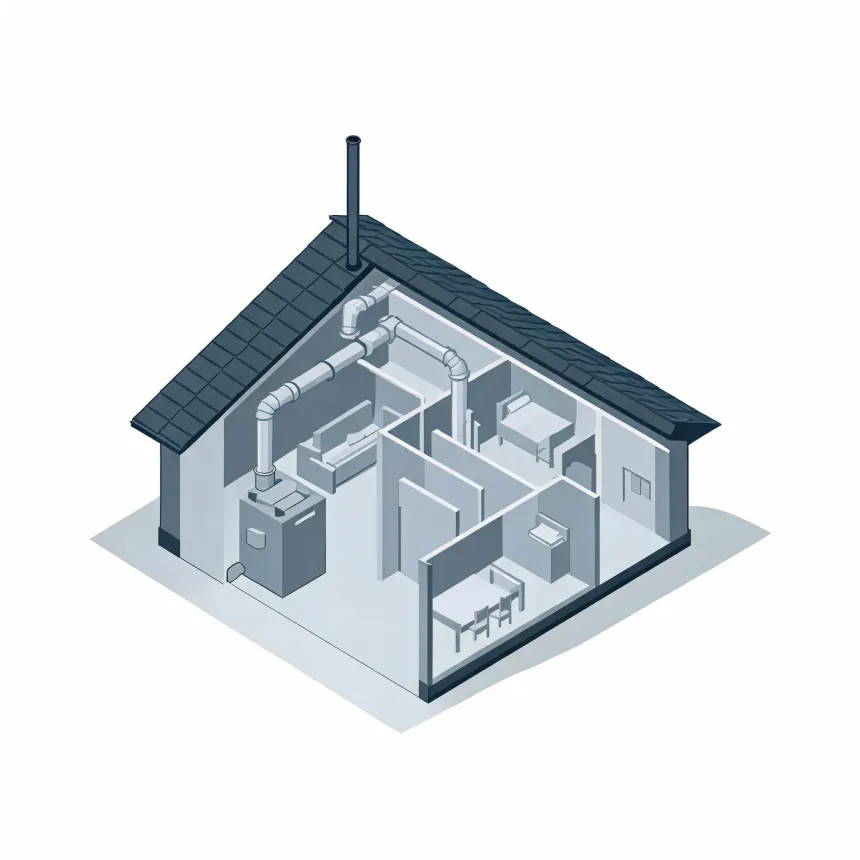
Isometric cutaway illustration of a small single-story house showing interior rooms with furniture, a furnace unit with attached ductwork running to a roof flue, and a dark shingled roof.
Your furnace works hardest from November through March.

NOAA nClimDiv, 1991–2020 normals

Furnaces in Batesville start up in November.

A weak part that made it through last March often fails in the first cold week of November.

Half these homes are older, but that's not what's failing

Half the homes here were built by 1988
Heat runs November through March
Winter nights average 35°F

Nothing about Batesville winters puts extra strain on a furnace. Mississippi stays mild compared to most of the country, and that holds here too. So when a furnace breaks down, it's usually one failed part, not a system worn out from overwork. An igniter that's given out. A flame sensor coated with residue. A blower motor on its way out. None of that has much to do with how cold it gets outside. Electricity in Mississippi runs $39.26 per million Btu, so if the fix involves a blower running longer than it should, that cost shows up on the bill. Finding the part that actually failed means fixing that, not replacing more than needs replacing.

Get the real cause found before you pay to replace anything

Mississippi households lose power often enough that a furnace here may have sat through an outage this year. That's worth mentioning to whoever comes out, since a hard restart can be what pushed a weak part the rest of the way out. Either way the fix is the same. Find the one part that failed and replace that.

Find a contractor
A man in a gray t-shirt and brown work pants carries a canvas tool bag up porch steps toward a blue front door of a house with gray siding.
A gray gas furnace with attached ductwork and piping installed in an unfinished concrete basement.

Five months on, five off, most years

A furnace that sat through an outage this winter, or one that's been running rough since last March without anyone looking at it, points to a different fix than one that's just old. Panola County has seen its share of winter storms this past decade, enough that a hard restart somewhere in there is worth mentioning to whoever comes out. None of that tells you what's wrong on its own, but it tells them where to look first.

The noise usually comes first

A furnace that bangs when it starts, rattles while it runs, or squeals on startup is telling you a part is loose, worn, or struggling to turn. A bang on startup can mean gas is building up before it lights instead of lighting right away. A squeal often points to a blower motor or its bearings. None of these get quieter on their own.

Short cycling means something is cutting it off

If your furnace keeps shutting down a few minutes after it starts, something is tripping a safety switch before the cycle finishes. A dirty flame sensor, a clogged filter, or a failing limit switch can all cause this. The furnace isn't choosing to stop. Something is telling it to.

A cracked heat exchanger is the clearest case. Run it a little while and the furnace still works fine, but that crack is now spreading every time the metal heats up and cools down again. Keep ignoring a dirty flame sensor and the furnace starts short cycling, which means more startups, and startup is when igniters and ignitors take the most stress. A blower motor that's starting to struggle will draw more current to do the same job, and that heat has to go somewhere. None of these fix themselves by running longer. They get worse, and usually they get worse in a way that takes a second part down with them.

Most furnace repairs are not close calls. A cracked heat exchanger, a failed control board, or a compressor-level failure on the rare furnace that has one, those tell you what to do. A single worn part on a furnace that's otherwise sound tells you the opposite. What makes it harder is a furnace that's needed a few different repairs over a couple of years. No single fix is expensive enough to force the decision, but the pattern means something a one-off failure doesn't. A tech who's opened the cabinet can tell you whether the cracked part is isolated or whether the metal around it is starting to go the same way. That's worth more than a guess based on how the furnace sounds from the living room.