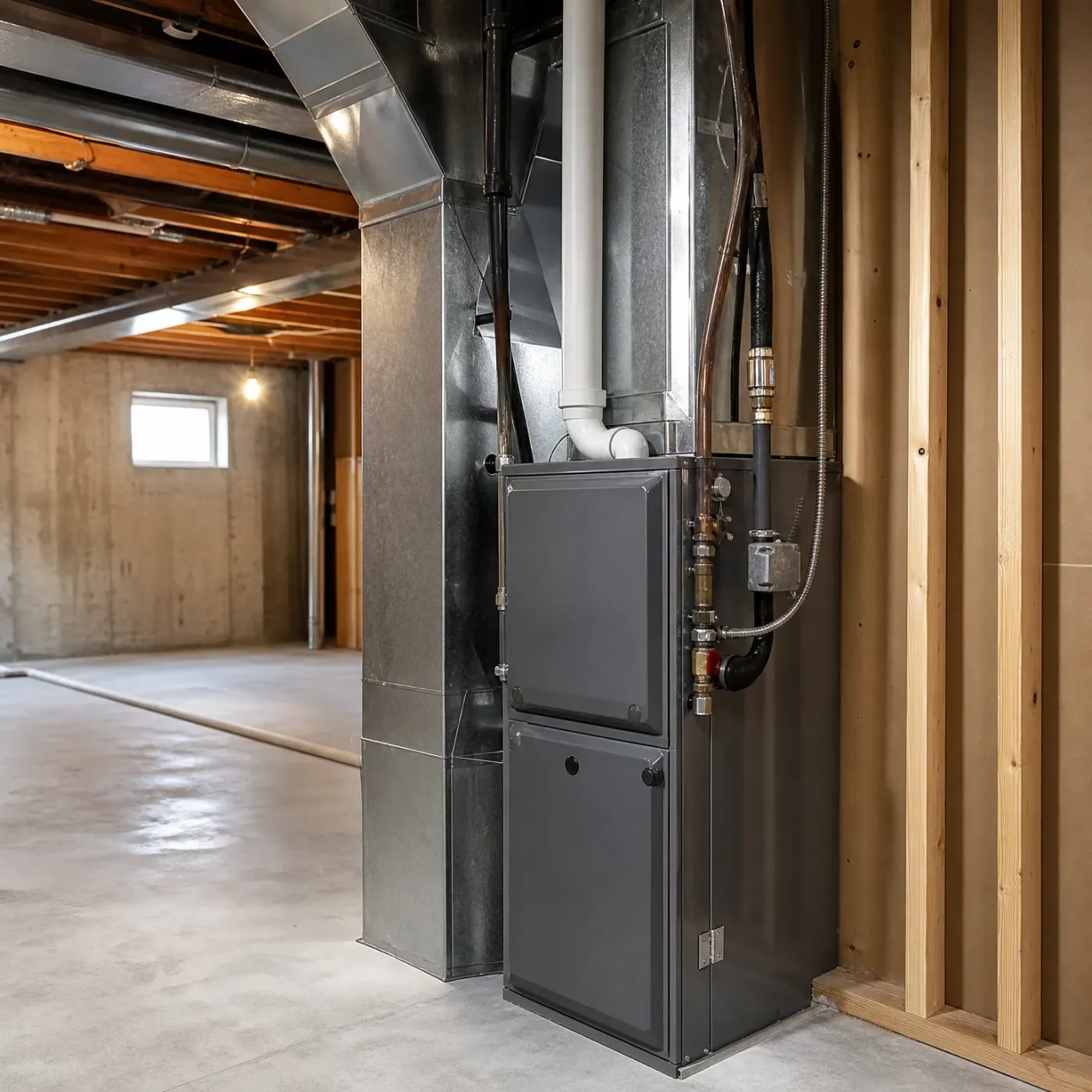
A gray high-efficiency furnace with two white PVC vent pipes stands beside galvanized sheet-metal ductwork in a dim basement with exposed joists and a concrete floor.

One request and it's handed off

How often to change your furnace filter in Mississippi

Most furnaces want a new filter every one to three months, but a dusty house or a pet can shorten that. With electric heat running most of the winter here, a clogged filter makes the system work harder the whole time. Below is how to tell when yours needs changing, and if it turns out your furnace needs a look, you can stop hunting for someone to call and let the right contractor come to you.

Hand it off

Most furnaces need a new filter every one to three months, and a one-inch filter, the kind in most homes, tends to sit at the shorter end of that. Electric furnace heat runs for long stretches through a Mississippi winter, and the fan pulls air through that filter every time it runs. Once the filter loads up with dust, the fan has to work harder to push air through it, and the furnace runs longer to heat the same rooms. That shows up on your power bill before it shows up as a breakdown. A filter that's gone gray or fuzzy, or one you can't remember changing, is already past due. Checking it monthly costs you a minute and tells you whether it needs changing now or can wait a few weeks. Letting it go is how a cheap part turns into a service call.

A smiling man in a gray long-sleeved shirt stands in a kitchen looking to the side, with open shelves of dishes, a white mug on the counter, a potted plant, and a view through a doorway into a living room.
A smiling bearded man in a green sweater sits at a white marble kitchen island with a mug, potted plant and bowl of fruit, in a bright white interior with open shelving and an arched doorway.
A smiling man with dark curly hair and a beard, wearing a dark green knit sweater, stands at a white marble kitchen counter with a dark blue mug, with open shelving, pendant lights and a houseplant behind him.
A smiling man in a green ribbed sweater stands behind a wooden table holding a ceramic mug of coffee in a kitchen with white subway tile, shelves of potted plants, and a bowl of fruit.

A one-inch filter doesn't have much surface area, so it catches dust fast and fills up faster than a thicker one. Every time the furnace fan kicks on, it pulls air through that filter, and a filter nobody's touched in months turns into a wall of packed lint instead of something air can move through. Once airflow gets choked down, the heat exchanger runs hotter than it's built to, and a lot of furnaces respond to that by shutting themselves off on a safety switch rather than keep running. You don't need to guess at this from a calendar. Hold the filter up to a light bulb. If you can't see light coming through it, it's already past the point of doing its job, no matter what month it is. This matters more if your furnace is paired with a fan set to run all the time for circulation rather than only kicking on during a heat cycle, since that pulls a lot more air, and a lot more dust, through the same filter over the same stretch of time.

What's Actually Happening Behind the Grille

  • A one-inch filter has less surface area to catch dust, so it loads up faster than a thicker four or five-inch media filter.
  • The fan pulls air through the filter every time the furnace runs, and a filter that's never swapped turns into a wall of packed lint.
  • Once airflow drops enough, the heat exchanger can run hotter than it should, and some furnaces will shut themselves off on a safety switch.
  • A filter you can't see light through when you hold it up to a bulb is already past the point of doing its job well.
  • Checking the filter against a bright light takes a few seconds and tells you more than guessing from the calendar.
  • Furnaces paired with a fan that runs constantly for air circulation pull more air through the filter than one that only runs on a heat cycle.
A gray high-efficiency furnace with two PVC vent pipes stands in an unfinished basement beside sheet-metal ductwork, a framed and plastic-covered wall, and a bare concrete wall with vertical pipes.
A clean filter lets the furnace pull air through freely, so the fan reaches temperature and shuts off the way it was designed to.
A gray furnace cabinet in a basement, connected to galvanized sheet-metal ductwork and white PVC pipes, against a concrete wall with exposed metal piping and insulation overhead.
A filter packed with lint forces the fan to run longer and harder to push the same air through it.
A furnace in a dim basement with a dirty pleated air filter partially pulled out of its slot, beside a water heater and concrete walls and floor.

You're down in the basement on a Saturday afternoon in October, the first cold snap of the year pushing you to check the furnace before you turn it on for good. You slide the filter out to look at it and stop. It's gray, almost felted, the pleats packed flat with lint so you can't see light through it. You can't remember the last time you changed it, maybe when the weather turned last spring. The furnace ran all through the muggy months just moving air for the AC, and somewhere in there this got away from you. You set it on the concrete floor and go looking for the box of replacements you know you bought.


Why does my house feel dusty with the heat on

You notice it a few weeks into winter. A film on the TV stand you just wiped down, dust along the floor vents, maybe someone in the house sneezing more than usual. The air coming out of the registers can feel weaker than it used to, and some rooms take longer to warm up than others. A furnace fan working against a clogged filter still moves some air, just less of it, and what gets through carries more of what the filter should have caught. Left long enough, that strain on the fan is what leads to a burned-out motor or a cracked heat exchanger, repairs that cost far more than a filter ever does.

A smiling man with dark curly hair in a navy t-shirt sits on a gray couch indoors, with a large-leafed plant and a window in the background.
A bearded man in a plaid flannel shirt stands in a kitchen looking out a window toward snow-covered shrubs, with a steaming mug on the windowsill and potted plants on a shelf behind him.
A gray furnace with copper and flexible piping stands against a wood-framed wall in an unfinished basement, connected to galvanized sheet-metal ductwork and PVC venting, with a concrete floor and exposed joists.

Done looking for a furnace pro

Fill out one form instead of calling around for a furnace tune-up.

Send the form, and lining up the furnace tune-up stops being yours to chase.

Skip the search

Sending the form costs nothing.

Does a dirty filter actually raise my power bill?

You've noticed the filter is dirty and you're wondering if that's actually costing you money, not just a theoretical problem the manual warns about. You want to know if it's worth doing anything about now or if it can wait until it's more convenient.

Yes, a clogged filter makes the fan run longer to move the same air

A dirty filter restricts airflow, so the fan has to run longer to push enough air past it and heat the house to the temperature you set. That extra run time uses more electricity. With most homes in Mississippi heating on electricity through the winter, that fan is already running for long stretches most days, and a clogged filter adds to every one of those cycles. It's not a dramatic jump on any single bill, but it adds up over a winter, and it's one of the few furnace problems you can see with your own eyes and fix yourself in a few minutes, without opening a panel or calling anyone.

A gray furnace cabinet in a basement with sheet-metal ductwork, white PVC vent pipes, and black gas piping against a concrete wall and wood-framed partition on a bare concrete floor.

Filter changed on schedule

This is what a furnace looks like when the filter gets swapped before it loads up. Air moves through the duct and into the plenum without the fan straining, and the burner cycles the way it was built to. Nothing here is working harder than it has to.

A gray metal furnace with two white PVC vent pipes stands on a concrete floor beside galvanized sheet-metal ductwork in a basement or utility space with wood framing.

Filter ignored too long

This furnace has been pulling air through a clogged filter for a while. The fan runs longer each cycle to move the same air, and that strain adds up over a Mississippi winter. Rust and wear show up faster on a system worked this hard.

Winter nights average 38°F statewide

Winter nights here average 38°F, mild enough that the furnace isn't fighting single digits like it would up north. But mild doesn't mean idle. That electric furnace still cycles on most nights all winter to hold the house steady, and every one of those cycles pulls air through the filter. A clean one keeps those long, mild-weather runs from turning into strain on the fan.

NOAA nClimDiv 1991-2020 county normals weighted by homes

A beige high-efficiency furnace stands on a concrete basement floor beside sheet-metal ductwork, with white PVC vent pipes and a gas line running along an insulated wood-framed wall.

Filter changed, furnace running clean

This is what the equipment looks like when the filter still has room to breathe. Air moves past the flue pipes and into the air handler without the fan fighting for it, and the burner lights, runs, and shuts off on its own schedule.

An older metal furnace with a louvered front panel stands against a concrete basement wall, connected to sheet-metal ductwork and a flue pipe, with copper and steel pipes running alongside.

Filter overdue, furnace straining

This cabinet has been sitting with the same filter in it too long. Dust has built up on the louvered vents and in the ductwork above, and the fan behind that panel is pulling harder than it should just to move the same air through the house.

A closed dark laptop and a ceramic mug of coffee on a wooden dining table, with wooden chairs, a dark kitchen cabinet with cutting boards and a potted plant, and a leafy plant by a window in the background.

Check it, don't guess

A one-inch filter wants changing every one to three months, sooner if there's a pet or a lot of dust in the house. That's the whole answer. The furnace tells you the rest if you look at the filter instead of the calendar, since a house that runs dustier than most will load one up faster than the three-month mark suggests.

If yours is gray and packed flat, it's done, no matter what the date says. If a technician needs to look at the furnace itself, that's a different search: finding one who'll show up, quote it straight, and not leave you calling around to three companies and explaining the same noise or the same bill three times. Send the form and that part is off your plate.

A gray upholstered sofa with a matching cushion sits beside a potted plant and a wooden table holding a small green plant in a stone pot, near a curtained window.
A dimly lit unfinished basement with concrete walls and floor, exposed floor joists, a small window at left, and a dark furnace with PVC venting and sheet metal ductwork at right.

It's off your list after this

Skip calling around to set up a furnace tune-up.

Tune-up, service, or cleaningFurnace or heatingMississippi
Step 1 of 2

What ZIP code is the job in?