Single-story brick and siding houses with lawns behind a long trimmed hedge, framed by large oak branches draped with Spanish moss under an overcast sky.

Heat Pump Installation in Vicksburg, MS

Tell us about the job

Takes about a minute. No obligation.

New system or replacementHeat PumpWarren County, MS
Step 1 of 2

What ZIP code is the job in?

The rating describes the unit, not your ductwork

The rating on the label measures how well the heat pump turns electricity into heat or cooling under controlled test conditions. It says nothing about how much of that conditioned air actually reaches your rooms. A high-rated heat pump connected to leaky or undersized ductwork will never perform the way the label suggests.


A higher rating usually means different equipment inside

A heat pump with a higher rating usually has a variable-speed compressor instead of a single-speed one, so it can run at a lower output for longer stretches rather than switching fully on and off. That changes how steady the temperature feels in the house and how the system sounds while running, which is worth asking about when you compare models.

5 months
November through March, your system heats
6 months
May through October, it cools
39°F
the average winter night it heats against
91°F
the average summer afternoon it cools against
Isometric line illustration of a cutaway house showing interior rooms, an air handler with ductwork in the attic space, and an outdoor condenser unit beside the exterior wall.
Your system heats November through March and cools May through October.

NOAA nClimDiv, 1991–2020 normals

Warren County has seen 145 damaging wind events between 2015 and 2024.

A heat pump installed in Vicksburg needs to handle outages along with the heat and cold.

Install before November, and the heat pump settles in before it has to work

Cooling runs May through October
Heat runs November through March
145 damaging wind events from 2015 to 2024

Electricity heats 61.3% of occupied homes in Warren County, so most houses already have what a heat pump needs. If that's what your home runs on now, a heat pump takes the place a furnace or electric resistance coil used to sit in. The wiring and the panel are already set up for electric heat. Switching to gas would mean running a new gas line to the house, which is a far bigger job than swapping the equipment. Staying electric keeps the installation close to a replacement instead of a rebuild.

Any heat pump installed here has to meet 14.3 SEER2 and 7.5 HSPF2

That is the federal minimum for this region as of January 2023, higher than the national manufacturing standard. It narrows what a contractor can legally install in Vicksburg, so it's worth asking upfront whether a quoted system clears that bar.

Find a contractor
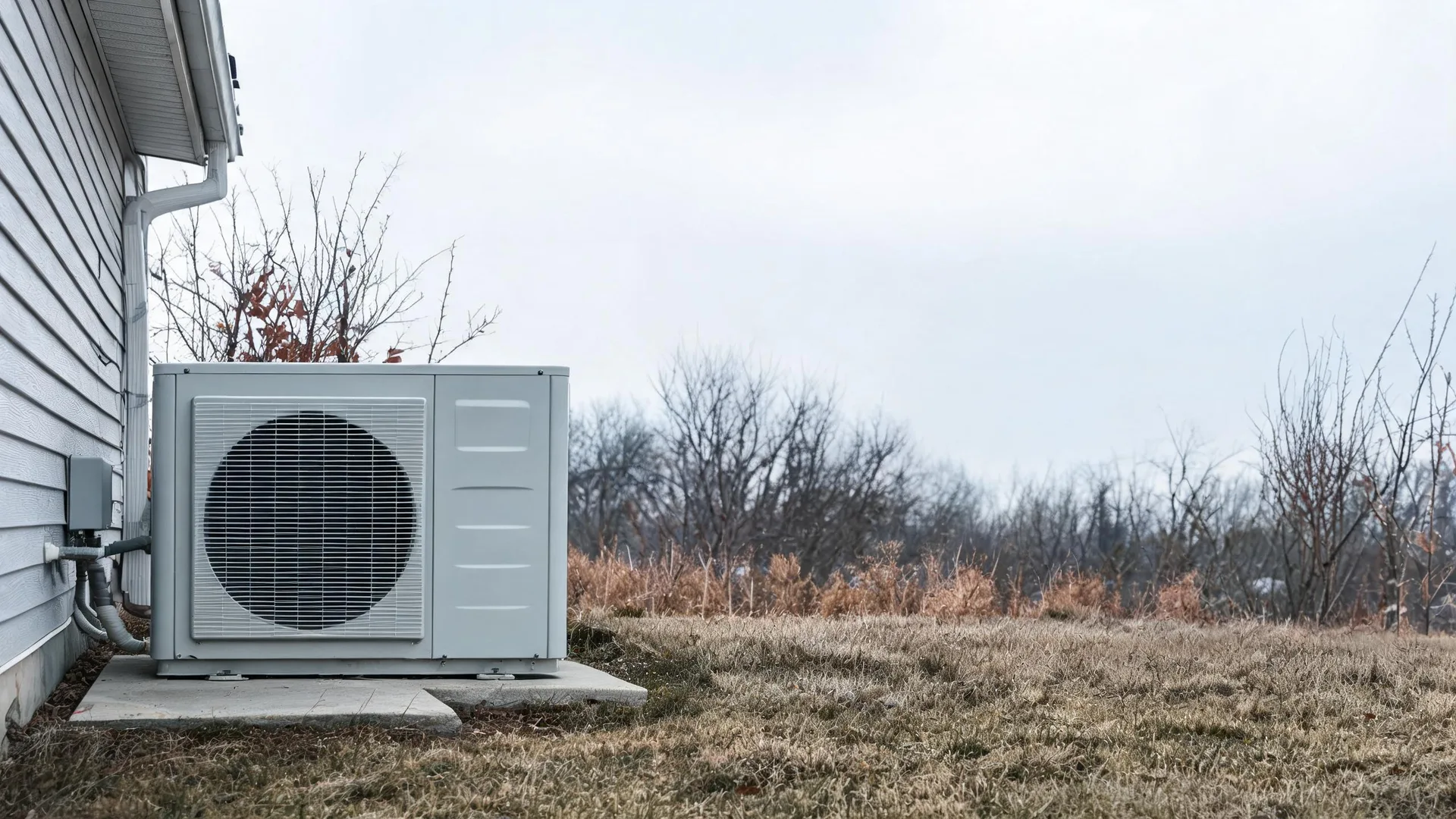
A white mini-split heat pump outdoor unit mounted on a concrete pad beside a gray-sided house, surrounded by gravel and green shrubs.

This system runs year round, so ask what carries that load

A heat pump runs every day of the year, not just in the hardest months of summer or winter, since it handles both jobs a furnace and an air conditioner used to split between them. That means the compressor sees far more total run hours over its life than either of those machines did alone. When you compare systems, ask what the compressor is rated for and whether it's a variable-speed or single-speed design, because that part carries the load the whole time the system is heating or cooling. Ask about the defrost cycle too. In cold weather a heat pump has to reverse itself and melt off any frost that builds on the outdoor coil, and how often it does that affects both comfort and wear. A system that defrosts efficiently loses less heat into the yard and spends more of its life actually conditioning the house. Also ask what happens at the lowest temperatures it will face. Some heat pumps lean on a backup heat strip when the outdoor air gets too cold to pull much heat from, and that backup heat costs more to run than the compressor does. Knowing where that switchover point sits on a given model tells you how much of the season the system handles efficiently on its own.

The old equipment has to come out first

If a furnace is coming out, the gas line serving it needs to be capped off properly, not just shut at the valve. If it's a straight swap for an old air conditioner, the line set often gets replaced along with the coil rather than reused, since old refrigerant and old copper don't always suit the new system. Whatever gets removed has to be hauled off and any refrigerant in it recovered, not vented, which is a legal requirement either way.

The switch changes what sits in the house, not just outside

An old central air system kept a furnace or an air handler indoors and a condenser outside. A heat pump uses an air handler too, but it may call for a different coil and sometimes a different thermostat, since a heat pump thermostat has to manage the reversing valve and backup heat that a plain AC or furnace setup never needed. If the old furnace is staying in as backup heat, it has to be wired to work alongside the heat pump, not against it.

The equipment itself is one number on the quote, but what it takes to put it in is another, and that second part depends on the house more than the brand. A straight swap, same spot outside, same ducts, same electrical, is the simplest version of this job. Anything beyond that adds work. If the panel doesn't have room for a new circuit, that's an electrician's job before the heat pump ever gets set. If the ductwork was sized for a furnace that ran hotter air than a heat pump does, it may need changes to move enough air at the lower temperature a heat pump supplies. Where the outdoor unit sits matters too, since it needs clear airflow on all sides and a path for condensate and defrost water to drain away from the house. None of that shows up on the unit's label, but all of it shows up on the invoice.

Most installs run one day, start to finish, though a few spill into a second. The crew pulls the old equipment first, then sets the new outdoor unit on its pad and the indoor coil or air handler wherever the old one sat. Once the line set is run and connected, the system gets evacuated to pull moisture and air out of the lines before any refrigerant goes in. That step matters more than people think, since trapped air or moisture in the lines will wear on the compressor long after the crew is gone. After startup, a tech checks refrigerant charge, airflow at the registers, and that the thermostat is actually talking to the reversing valve. They should also walk the house with you and show what the backup heat does and when it kicks in, since that's the one part of a heat pump system that behaves differently from a furnace or plain air conditioner.