





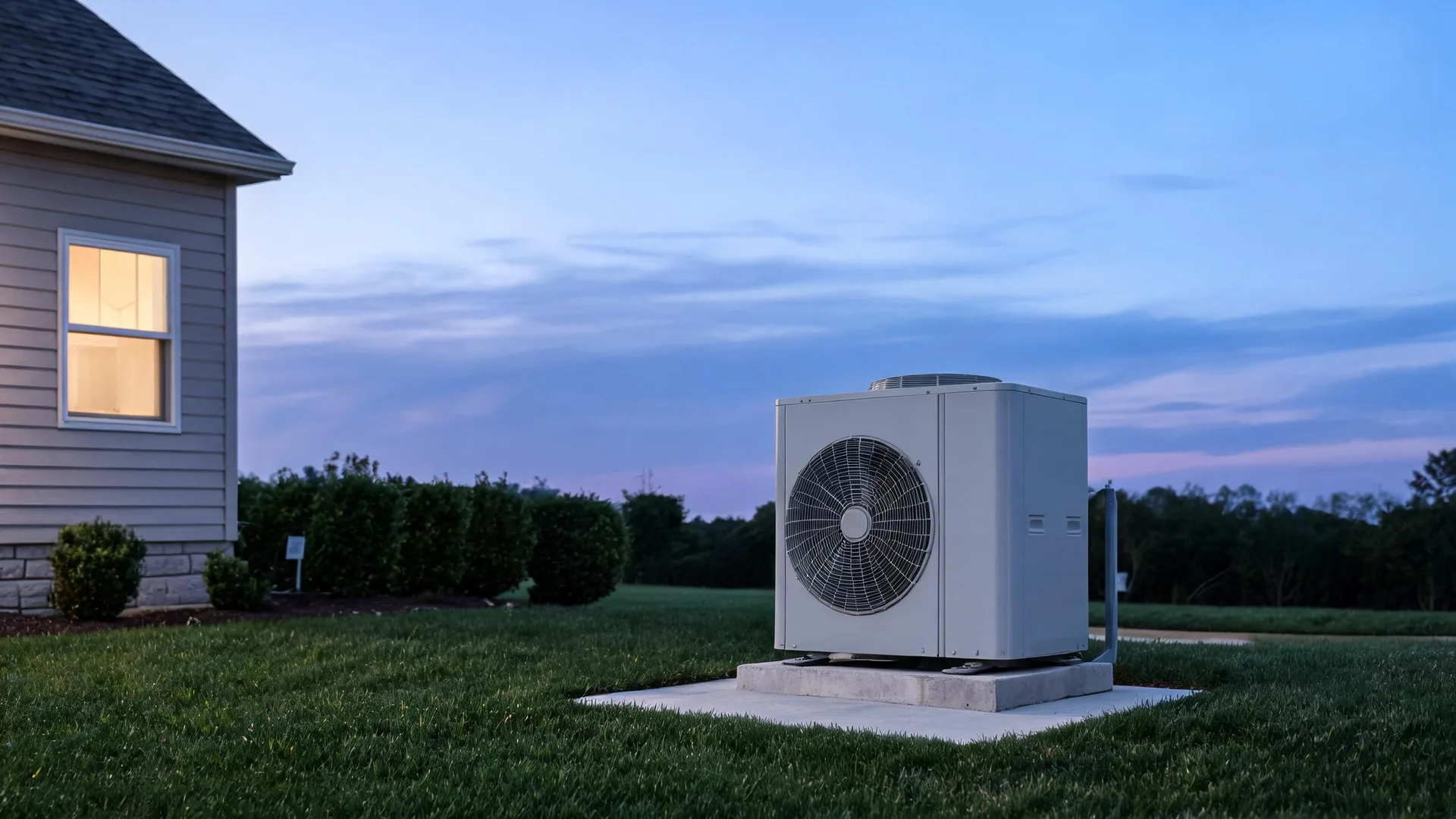
A large outdoor air-conditioning unit mounted beside a vinyl-sided house, surrounded by mulched garden beds and green shrubs.

Heat Pump Installation in Fulton, MS

Tell us about the job

Takes about a minute. No obligation.

New system or replacementHeat PumpItawamba County, MS
Step 1 of 2

What ZIP code is the job in?

Just over half the homes in Itawamba County heat with electricity, more than any other fuel. Utility gas comes next at 31.6%, with propane heating another 12.3%. A heat pump fits right into that electric majority, since it runs on the same fuel most homes already have. For a home already wired for electric heat, installation means swapping out equipment rather than bringing in a new fuel source.

5 months
November through March, your system heats
5 months
May through September, it cools
34°F
the average winter night it heats against
90°F
the average summer afternoon it cools against
Isometric illustration of a cutaway single-story house showing interior ductwork, an indoor air handler and simple furniture, connected by lines to an outdoor condenser unit beside the building.
Your system heats November through March and cools May through September.

NOAA nClimDiv, 1991–2020 normals

Mississippi electricity ran 13.39 cents per kilowatt-hour in 2024, below most of the country.

A high-efficiency heat pump still costs more up front, and cheap power here means it takes longer to earn that back.

Get a heat pump in before October, and it's working on your schedule all winter

Cooling runs May through September
Heat runs November through March
Power costs 13.39 cents a kWh statewide

Itawamba County gets its share of rough weather, including damaging wind and a handful of tornadoes most years. None of that changes what size or efficiency heat pump fits your home. Sizing comes down to square footage and layout, not storm counts. Where the weather does matter is the power itself, since a heat pump needs electricity to run whether it's heating or cooling. Close to a third of Mississippi households lost power for at least a day in 2024, which is worth a conversation about backup rather than a reason to size up the unit.

The right size comes from your home, not the county

Half the homes in Itawamba County were built in 1984 or earlier, half in 1984 or later. Mobile homes make up 19.5% of the housing here. None of that changes what size heat pump fits a given house. That comes down to square footage and layout, the same as anywhere else.

Find a contractor
A dark gray heat pump unit mounted on a concrete pad next to a house with gray siding and a stone veneer wall.

What years of cycling does to the old unit

An old heat pump that's been running for years doesn't fail all at once. The compressor works harder to hit the same temperature, cycles get longer, and the outdoor coil может struggles more in the cold stretch of winter. Refrigerant leaks get more common as the lines and fittings age. Eventually it's running close to constantly and still falling short on the coldest days, or the defrost cycle starts kicking in more than it should. None of that happens on a schedule. It happens to the compressor, the reversing valve and the coil through thousands of start-stop cycles, year after year, until the parts just wear thin.

Load calculation, not square footage alone

A contractor works out heat pump size with a room by room load calculation, checking window area, insulation, ceiling height and how the rooms connect, not just the total square footage. Homes the same size can need different size units if one has more window area or an uninsulated bonus room over the garage.
Oversized runs worse than undersized

A heat pump that's too big for the house cycles on and off fast, hitting the thermostat setting before it's run long enough to pull moisture out of the air or warm the place evenly. Short cycling also puts more wear on the compressor over time. The right size runs longer, steadier cycles, which is what actually keeps a home comfortable.

A heat pump installation isn't just the outdoor unit and the price tag on it. The job includes the line set, the air handler or the coil paired with existing ductwork, the thermostat, and the electrical work to feed the new equipment. If the ductwork is undersized or leaky, bringing it up to handle the system properly adds to the job. Electrical matters too, since a heat pump may need a dedicated circuit or a panel that has room for it, and older panels sometimes don't. Efficiency rating plays into it as well, since a higher efficiency unit costs more than a basic one. Removal and disposal of the old equipment is part of the job too, not an extra step tacked on.

Installation day starts with the old equipment coming out, the outdoor unit, the air handler or coil, and the line set if it's not being reused. Then the new line set gets run and connected, and that connection has to be done right, since a proper brazed joint and a clean vacuum pull on the lines keep moisture and air out of the refrigerant system. Once the lines are tight and tested, the electrical gets hooked up, the new outdoor unit gets set on its pad, and the indoor coil or air handler goes in. The system gets charged with refrigerant to the manufacturer's spec, not just topped off by feel. Last comes startup, where the contractor checks airflow, checks the temperature split across the coil, and sets the thermostat to make sure the system is actually doing what it's supposed to before they leave.