







A gas furnace and sheet-metal air handler unit installed in an unfinished concrete basement.

Furnace Repair in Lucedale, MS

Tell us about the job

Takes about a minute. No obligation.

RepairFurnace or heatingGeorge County, MS
Step 1 of 2

What ZIP code is the job in?

Your furnace only has to work about five months a year here, November through March. Overnight lows in that stretch average 40°F, which is mild as winters go. The rest of the year it just sits. A furnace that isn't pushed hard tends to hold up well, so if something's gone wrong with yours, age or a neglected part is the more likely cause than years of hard use. That usually means a repair is worth doing rather than a sign the whole unit is worn out.

5 months
November through March, your furnace is on duty
40°F
the average winter night it heats against
Isometric cutaway illustration of a single-story house showing interior rooms with a dark furnace unit, connected ductwork, a vertical flue pipe through the roof, and simple furniture, on a white background.
Your furnace works hardest from November through February.

NOAA nClimDiv, 1991–2020 normals

Half the homes in George County were built in 1989 or later.

A furnace that came with a newer home still has years left in it, so a broken part is usually worth fixing.

George County gets its share of storms, but none of it wears out a furnace

55 severe weather events from 2015 to 2024
30% of homes statewide lost power a day or more in 2024
30 damaging wind events from 2015 to 2024
Furnace trouble in Lucedale usually shows up in NovemberThat's the first month furnaces run here, after sitting idle since March.

A furnace that's had an easy life is usually a good candidate for repair instead of replacement. If yours is short cycling, blowing cool air, or won't light, get someone to look at the actual part before you write off the whole system. A cracked igniter or a bad flame sensor is a common fix, and on a unit that's only worked five months a year, that's often all it is. The exception is a furnace that's been skipped on maintenance for years. Neglect catches up with a machine no matter how easy its climate is.

If your house is newer, your furnace probably is too

Get the part looked at before you consider replacing the system. In a house built recently enough, the furnace is nowhere near the end of its life.

Find a contractor
A man in a cap, work jacket and tan trousers carries a canvas tool bag up wooden porch steps toward a blue front door of a house with lap siding.
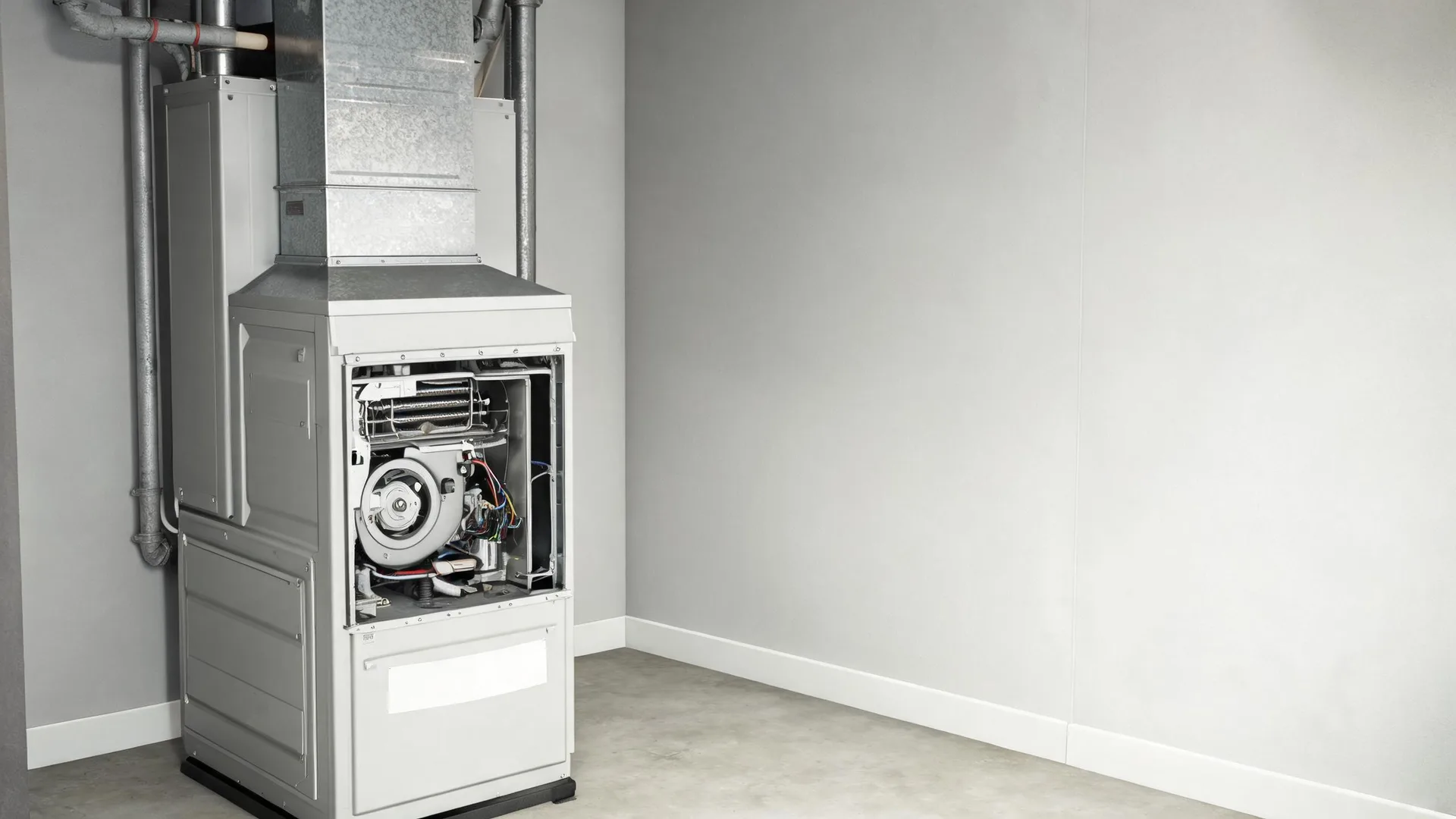
A gray residential gas furnace installed in an unfinished basement, surrounded by ductwork, a metal flue pipe, and a gas supply line.

Furnaces fail one part at a time, not all at once

Most furnace failures come down to one part giving out, not the whole system wearing down. The igniter cracks after enough heat cycles and stops glowing hot enough to light the gas. The flame sensor collects a film of residue and can't tell the burner it's lit, so the furnace shuts itself off as a safety check. A draft inducer motor can wear out on its bearings, and the furnace won't start at all because it can't prove the exhaust path is clear. These parts fail from age and from dust, not from how hard the furnace has been running. That's why a unit that's had an easy few months a year can still turn up with a cracked igniter or a dirty flame sensor. It's also why a furnace that gets checked once a year tends to avoid these failures well past when a neglected one would have them.

What you can check yourself

Check the thermostat is set to heat and the temperature is actually above room temperature. Check the furnace switch, it looks like a light switch on or near the unit, and make sure it's on. Check your breaker panel for a tripped breaker. If you have a gas furnace, check that the gas valve is open and that any other gas appliance in the house is working. Check the air filter, a filter packed with dust can choke airflow badly enough that the furnace shuts itself down to protect itself.
What to leave alone

Don't open the burner compartment or touch the igniter or flame sensor yourself, they're fragile and a fingerprint on a flame sensor can cause the exact no-heat problem you're trying to fix. Don't hold down a reset button repeatedly if the furnace is locking out, that usually means a safety switch is doing its job and needs a tech to find out why. If you smell gas, don't flip switches or look for the problem at all, leave the house and call the gas company first.

Most furnace trouble gives you a warning before it quits outright. A burner that used to light right away starts taking longer, or you hear clicking that doesn't catch. Air comes out cooler than it should, like the furnace is running but not really heating. Some furnaces start short cycling, shutting off before the house ever warms up. Others get loud, a rattle or a squeal that wasn't there before, usually the inducer motor or a loose panel. Any of these is worth a call before the furnace picks the coldest night to quit for good.

Repair and replacement come down to one question. Is the rest of the furnace still good, or is this part just the first of many to go. A single failed igniter or flame sensor on a furnace that's otherwise sound is a straightforward fix. The rest of the unit doesn't know or care that one part broke. What changes the math is a furnace that's already had other repairs, or one where the heat exchanger itself is cracked or rusted through, since that part isn't something anyone patches. Age matters too, but only as a clue to how many more parts are likely close behind this one. If a tech tells you the blower motor and the inducer are both worn and the circuit board is original, that's a different conversation than a single bad sensor. Ask what else they're seeing while they're in there, not just what broke.