






A tall red brick wall with a row of shrubs runs along the left side of a mown lawn, with a single-story light-colored house and tall pine trees in the background under an overcast sky.

Furnace Repair in Crystal Springs, MS

Tell us about the job

Takes about a minute. No obligation.

RepairFurnace or heatingCopiah County, MS
Step 1 of 2

What ZIP code is the job in?

A furnace that's starting to fail usually tells you before it quits outright. Listen for a boom at startup instead of a soft whoosh, that's gas building up before it lights, and it means the igniter or burners need a look. Short cycling, where it runs a few minutes and shuts off, often points to a clogged filter or a cracked heat exchanger tripping the limit switch. If the blower runs but the air isn't warm, the gas valve or igniter may not be doing its job. A yellow flame instead of blue is worth calling in right away, it can mean the furnace isn't burning clean. Any of these is a reason to get it checked before it leaves you without heat on a cold night.

5 months
November through March, your furnace is on duty
39°F
the average winter night it heats against
4 winter storms
in ten years, the nights a failure hurts most
Isometric cutaway illustration of a small house showing a furnace unit connected to ductwork and a vertical flue pipe extending through the dark shingled roof, with sparse furniture in the rooms.
Your furnace works hardest from November through February.

NOAA nClimDiv, 1991–2020 normals

Half the homes in Copiah County were built in 1985 or later, which means half were built before that.

A furnace that old can still run fine, but a breakdown now is your cue to ask whether it's worth another repair.

Five months of heat a year is a light workload for a furnace

Heat runs November through March
Winter nights average 39°F
Climate zone 3A
Built to start cold in NovemberFurnace season runs November through March here, and most trouble shows up in those first cold weeks.

A tech starts by asking what the furnace is doing and when it does it. Then it's a look at the filter, the flame, and the flue before anything gets taken apart. Most of the work happens with a multimeter, checking the igniter for continuity, the flame sensor for a clean signal, the limit switch for proper operation. If the furnace short cycles or won't fire at all, the control board can usually point to why through a blink code on its display. Opening the cabinet to check the heat exchanger for cracks or soot comes next if everything else checks out fine. By the end, you should know exactly what's failing and what it'll take to fix it.

A light workload, so repair usually makes sense

Five months of real work a year means most furnace trouble here is a single part worn out, not a system worn down. Worth fixing.

Find a contractor
A man in a dark long-sleeve shirt and tan pants climbs porch steps toward a blue front door, carrying a worn canvas tool bag with tools in its side pockets, beside a potted shrub in a blue planter.
A gray residential gas furnace installed in an unfinished basement, surrounded by ductwork, a metal flue pipe, and a gas supply line.

Running it longer rarely helps

A cracked heat exchanger gets worse with every hour the furnace runs after it cracks. Heat makes metal expand, and a hairline crack opens wider each time the burners fire, then closes a little as it cools. Keep running it and that small crack becomes a bigger one. A flame sensor coated with a thin film still mostly works, until the film builds up enough that the furnace reads no flame and shuts itself off for good. Dirty flame through a fouled burner leaves soot behind, and that soot narrows the passage further, so the flame gets worse at its own pace once it starts. A blower motor running on a failing bearing is the same story. It gets hot, it gets loud, and it keeps going right up until it seizes. None of these fix themselves by running longer.

What's safe to check yourself

Shut the furnace off and look at the filter first. If it's gray and matted, swap it before anything else. Check that the thermostat is set to heat and the temperature is actually above room temperature. Walk over to the furnace and make sure the switch on or near it, it looks like a light switch, is flipped on. Check the breaker if the furnace won't do anything at all, no lights, no sound.
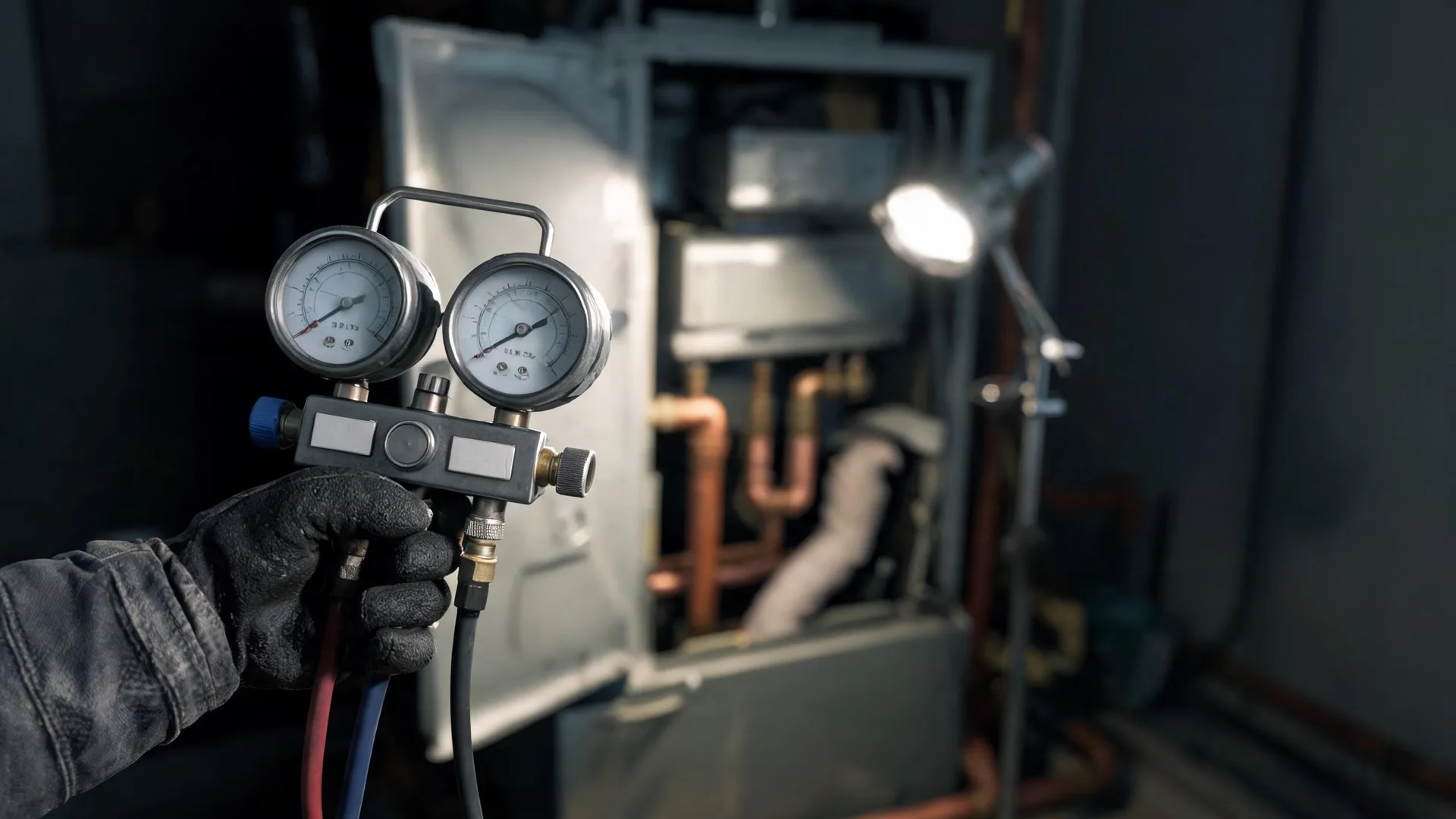
What to leave alone

Don't take the cabinet apart or go near the burners or the flame sensor. A flame sensor reads wrong if it's handled wrong, and a gas connection isn't something to loosen and retighten on a guess. If you smell gas, don't flip switches or check anything, get out and call the gas company from outside.

A lot of furnace failures trace back to dirt, not age. A clogged filter starves the system of airflow, and the heat exchanger runs hotter than it should every time the burners fire. That heat is what eventually cracks it. A flame sensor coated in a thin film stops sensing the flame it's supposed to see, so the furnace shuts down as a safety measure, not because anything is actually broken. Igniters wear out just from being heated and cooled over and over, the same way a light bulb filament eventually gives out. Blower motors fail at the bearings, and a motor running rough for a while is usually a motor close to seizing. Most of what sends a furnace in for repair is a single part reaching the end of what it was built to do, not the whole unit failing at once.

A repair decision comes down to what actually failed and what else is showing wear. A single part worn out on its own, an igniter, a flame sensor, a blower capacitor, is a normal repair on a furnace that's otherwise sound. The cabinet, the gas valve, the heat exchanger, those are built to outlast several smaller parts around them. Where it tips toward replacement is when the failure sits in one of those bigger, harder to reach parts, or when the furnace has already had a string of smaller repairs in close succession. A cracked heat exchanger is usually the clearest line, since it affects how safely the furnace can run at all, not just whether it runs. Age by itself doesn't decide it. What decides it is whether the part that failed is one furnaces are built to need now and then, or one they're built to need only once.