





An unfinished basement interior showing a gray furnace unit beneath a bare incandescent bulb, surrounded by exposed joists, concrete walls, cardboard boxes, and utility pipes.

Furnace Installation in Crystal Springs, MS

Tell us about the job

Takes about a minute. No obligation.

New system or replacementFurnace or heatingCopiah County, MS
Step 1 of 2

What ZIP code is the job in?

Electricity in Mississippi ran $39.26 per million Btu in 2024, cheaper than most of the country. That changes the math on a new furnace. A high-efficiency model still uses less power than a standard one, but with power this cheap, the extra cost of the top-tier unit takes longer to earn back in lower bills. For a lot of homes here, the better bet is a furnace that holds up through a hard freeze and comes back on clean after the power's been out, not the one with the highest efficiency number on the sticker. Fit and reliability matter more than squeezing out another few percent.

5 months
November through March, your furnace is on duty
39°F
the average winter night it heats against
80% AFUE
the federal minimum any new unit must meet
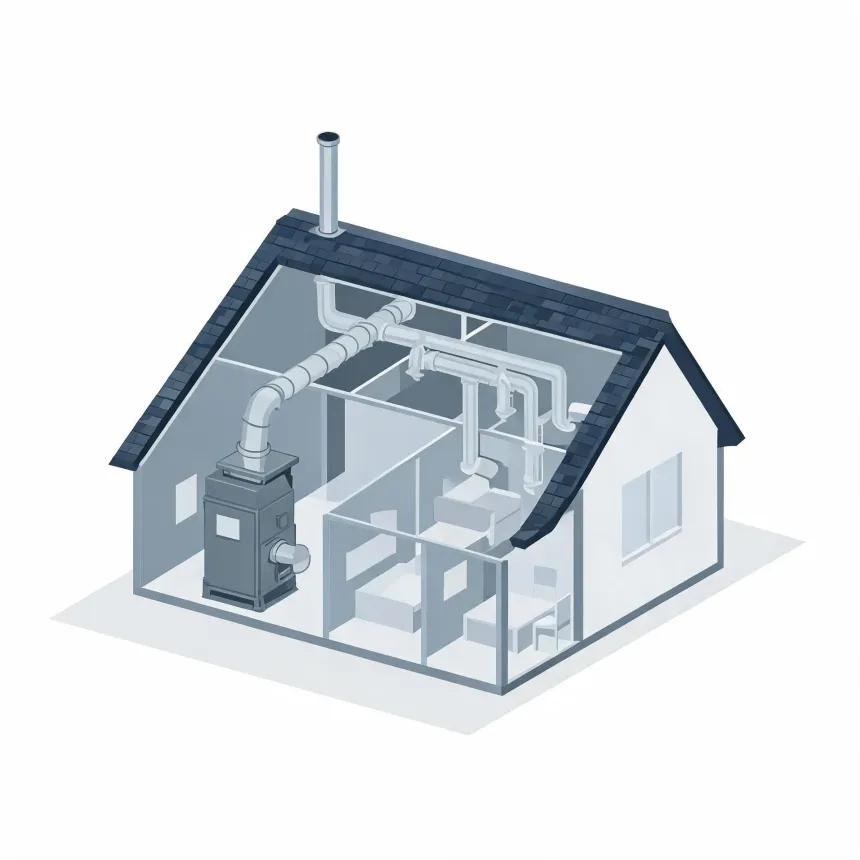
Isometric cutaway illustration of a small house showing a gray furnace unit with a flue pipe through the roof and branching ductwork running to rooms with simple furniture.
Your furnace works hardest from November through February.

NOAA nClimDiv, 1991–2020 normals

Half the homes in Copiah County were built in 1985 or earlier, half in 1985 or later.

Either way, a standard-sized furnace matched to your house is the right call here.

Five months of work a year is not much to ask of a furnace

Heat runs November through March
Winter nights average 39°F
Climate zone 3A

Electricity heats 57.8% of homes in Copiah County. Gas reaches 21.3%, and propane covers another 18.6%. That means most furnace installers here spend their time on electric furnaces and heat pumps, not gas units. If your house already runs on electric heat, putting in another electric furnace keeps the job simple. No gas line to run, no venting to add. If you're on propane, the new furnace has to match what your tank and hookups can deliver. Either way, matching the new unit to what the house already has is the straightforward path.

Reliability first

Power is cheaper here, so the most efficient model takes longer to pay off. Reliability and fit matter more.

Find a contractor
A man in a cap and brown jacket, seen from behind, climbs porch steps toward a blue front door while carrying a canvas tool bag, with a potted shrub in a blue planter beside him.
A gray residential gas furnace installed in an unfinished basement, surrounded by ductwork, a metal flue pipe, and a gas supply line.

Get it in before November asks for it

October is the month to get this done. Homes here start running heat in November and keep it going through March. Install before then and the furnace gets tested and adjusted while nothing is riding on it. Wait until the first freeze and you're installing under pressure, taking whatever unit and whatever schedule is available instead of what actually fits your house.

Sizing is a calculation, not a guess

A contractor works out furnace size from a heat loss calculation, room by room. That means measuring the square footage, checking window area and type, counting exterior walls, and looking at insulation and ceiling height. The furnace's output has to match what the house actually loses in cold weather. Going by the size of the old unit or a rule of thumb skips this step, and it's the step that gets the number right.
Oversized fails a different way than undersized

A furnace that's too big heats the house fast, shuts off, then starts again a few minutes later. That short cycling wears out the igniter and the blower motor well before their time, and it leaves rooms farther from the furnace never quite catching up. A furnace that's too small just runs long and can't keep up on the coldest days. The right size runs long steady cycles and wears evenly.

Ask what the warranty covers, parts or parts and labor, because those are different promises. Ask how the contractor arrives at the unit size, and expect to hear about a heat loss calculation, not a guess based on the furnace being replaced. Ask what happens to the warranty if someone other than the installer services the furnace later, since some manufacturers void coverage over that. Ask about staged heating, whether the furnace runs at a single fixed output or can step down for milder days, because that affects how evenly the house heats and how often the burner cycles on and off. And ask for the AFUE rating in writing. That number tells you how much of the fuel burned actually becomes heat in the house rather than going out the flue.

The old furnace comes out first, along with the old venting if it's not going to be reused. Then the new unit gets set, gas or electric connections made, and ductwork tied in, sealed at every joint so the furnace isn't pulling air from the attic or the space around it. The contractor checks gas pressure or electrical draw against what the manufacturer specifies, not just whether the burner lights or the blower spins. Before anyone packs up, the system should run through a full cycle while someone's still there to watch it, not just flip on and leave. That's when a weak connection or a bad seal shows up, not on the first cold night with nobody around to catch it.