





Two illuminated white Southern-style houses with wraparound porches and staircases, framed by a Spanish moss-draped tree on a quiet street at night.

Heat Pump Repair in Vicksburg, MS

Tell us about the job

Takes about a minute. No obligation.

RepairHeat PumpWarren County, MS
Step 1 of 2

What ZIP code is the job in?

A heat pump that's struggling will usually keep trying anyway, and that's where the damage starts. Take a refrigerant leak. Run it low on charge long enough and the compressor has to work harder than it's built for, and a compressor that overheats repeatedly can fail for good. Or take a dirty coil restricting airflow. Keep running it like that and ice can build up on the outdoor coil, and a unit that's icing over loses capacity while straining to make up for it. A weak capacitor is another one. It can let the system limp along for a while before the motor it's supposed to support quits altogether. The longer any of these run unchecked, the more of the system they end up dragging down with them.

5 months
November through March, your system heats
6 months
May through October, it cools
39°F
the average winter night it heats against
91°F
the average summer afternoon it cools against
Isometric cutaway illustration of a house showing attic ductwork, an indoor air handler, furnished rooms, and an outdoor condenser unit connected by lines along the exterior wall.
Your system heats November through March and cools May through October.

NOAA nClimDiv, 1991–2020 normals

Your heat pump switches over to cooling in May and back to heat in November, with October and April as the changeover months.

The first cold snap in November is when a weak part that made it through summer finally gives out.

Vicksburg took 145 damaging wind events from 2015 to 2024, and your heat pump rode out every one of them

145 damaging wind events from 2015 to 2024
Power costs 13.39 cents a kWh statewide
Climate zone 3A

Half the homes in Warren County were built in 1978 or later, half before that, and neither age tells you much about why your heat pump is acting up. A worn contactor or a choked filter shows up in houses of any age. Mobile homes make up close to a fifth of the housing here, and when the ductwork runs through unconditioned space, the unit does work harder, but that's a question about the install, not a mark against the house itself. Whatever's wrong with yours right now is most likely one part, not the whole system, and a contractor can usually find it in one visit.

Get it looked at early

Problems tend to show up in the first weeks of the season, when the load hits a part that was already weak.

Find a contractor
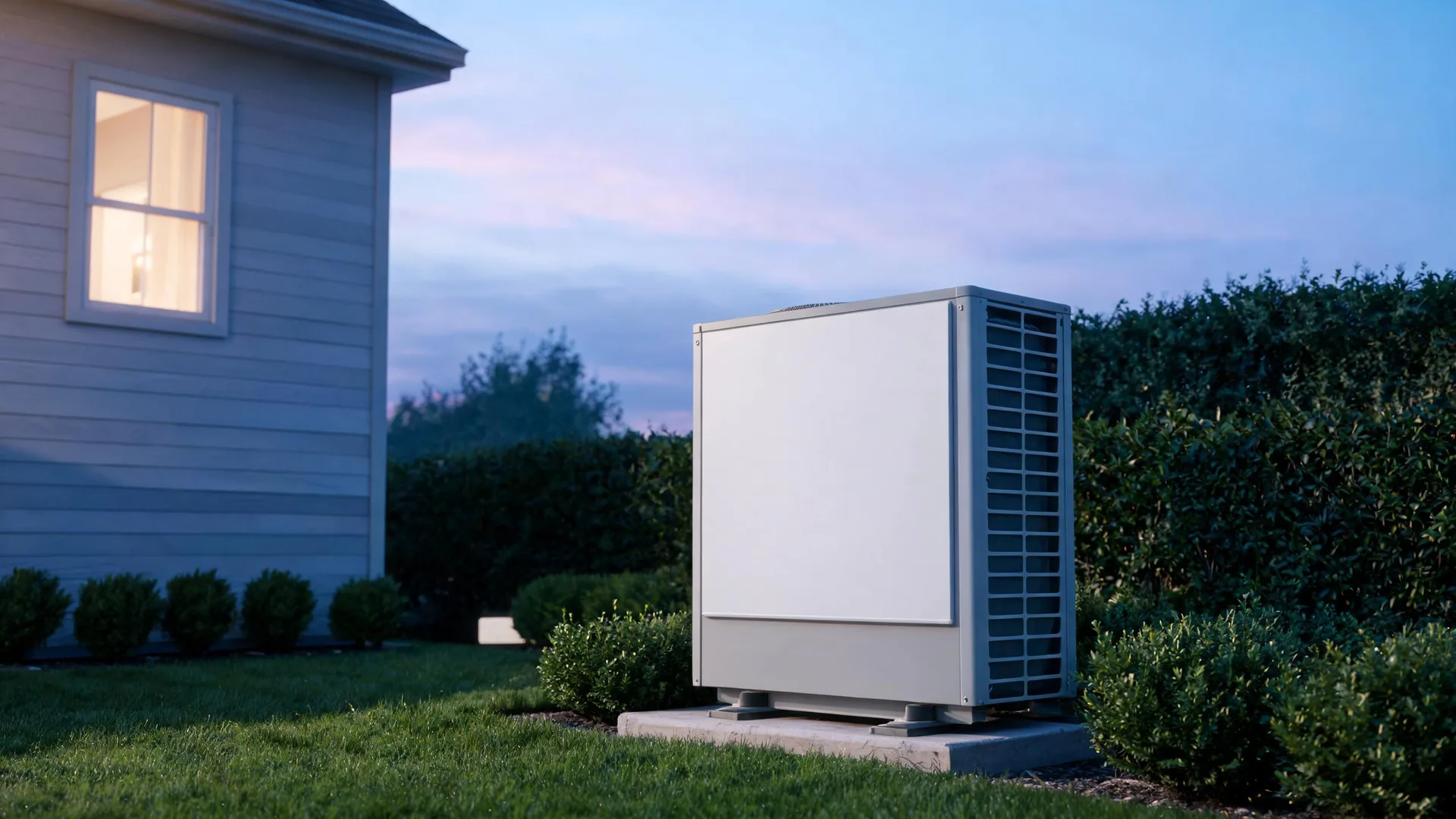
A gray outdoor HVAC unit mounted on a concrete pad beside a house with gray lap siding and a stone foundation.

What you can check yourself first

Before anyone comes out, there are a few things worth checking yourself. Look at the thermostat first. Make sure it's set to the mode you want and the temperature is actually past where the system would kick on. A battery dying in the thermostat can look exactly like a dead system. Next, check the filter. A filter clogged with dust chokes off airflow, and a heat pump starved for airflow will ice up outside or struggle to keep up inside. Go outside and look at the unit itself. Leaves, grass clippings, ice, or anything piled against the coil blocks it from doing its job, and clearing that away is safe to do yourself. Check the circuit breaker too. A breaker that's tripped will shut the whole system down with no warning sign indoors. None of this takes tools or know-how beyond what's already in the house. What you shouldn't touch is anything behind the panels, the wiring, the refrigerant lines, or the compressor itself. Those need gauges and training to deal with safely.

It's blowing air that doesn't feel right

Air coming out lukewarm instead of hot, or barely cool in summer, usually means the system is running but not doing its job. That can be low refrigerant, a stuck reversing valve, or a compressor that's losing strength. The fan still spins so everything seems fine at a glance, but the heat pump isn't moving enough heat either direction.
It's making noise it didn't used to make

A click every time it starts, a hum that won't turn into a run, or a hard bang from the outdoor unit are all worth paying attention to. These sounds usually mean a part is struggling to do what it used to do without effort. Waiting it out tends to turn a simple fix into a bigger one, since the part making the noise is usually the part about to fail.

A reversing valve is behind a lot of heat pump trouble that looks like something else. It's what switches the system between heat and cooling, and when it sticks, the unit keeps running but stops putting out the right temperature. Outdoor coils cause their own share of failures too, mostly from being left dirty or blocked by whatever's growing or piled up around the unit. A coil that can't shed heat properly forces the compressor to work past what it's built for, and compressors rarely recover once they've been pushed like that. Defrost control boards fail less often but take the whole heating side down when they do, since the unit needs that board to know when to switch into defrost and back. Most of these parts give some warning before they quit outright, which is the whole case for having a noise or a weak spot checked instead of waited out.

A diagnostic visit starts outside, at the unit itself. A contractor will check the refrigerant charge with gauges, look at the coil for dirt or ice, and listen to how the compressor sounds when it kicks on. Inside, they'll check the air handler, the filter, and the thermostat signal, since a heat pump can be blamed for a problem that's really a dirty filter or a bad sensor. They'll run the system in both directions, heat and cooling, because a reversing valve can work fine one way and stick the other. Most of this gets done with gauges and a multimeter, not guesswork, and a tech who's found the actual part at fault can usually tell you on the spot whether it's a quick fix or something that needs parts ordered.