Low ground-level view across a lawn toward a single-story brick house with a dark shingled roof, framed by a large moss-draped oak and tall pine trees under an overcast sky.

Heat Pump Repair in Senatobia, MS

Tell us about the job

Takes about a minute. No obligation.

RepairHeat PumpTate County, MS
Step 1 of 2

What ZIP code is the job in?

Trouble shows up in November

Heat pumps in Senatobia switch over to heat mode in November, and that first cold stretch is when a weak part finally gives out. A compressor or defrost board that was already struggling can get through a mild October and then fail once it has to work for heat.

Get it looked at before the cold sets in

If your heat pump struggled last winter or is already short cycling, have it checked in October before homes here start running heat. A contractor can catch a failing part while it is still just a repair, not a no-heat call in the middle of a cold night.

5 months
November through March, your system heats
5 months
May through September, it cools
34°F
the average winter night it heats against
90°F
the average summer afternoon it cools against
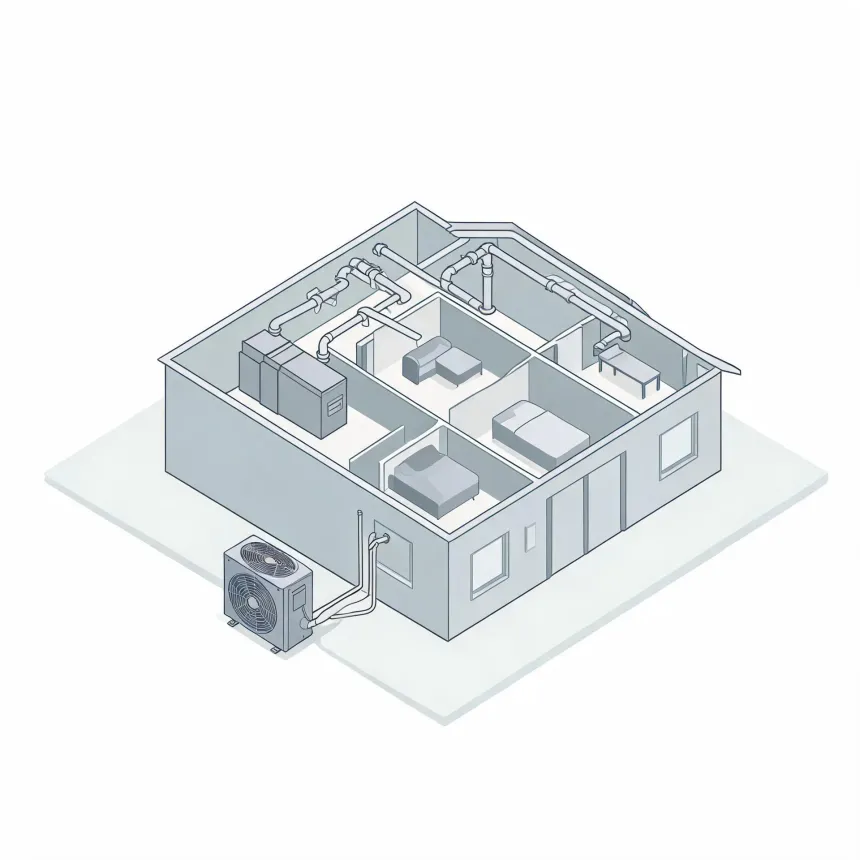
Isometric line illustration of a cutaway single-story house showing interior rooms with beds and furniture, ceiling ductwork connected to an indoor air handler, and an outdoor condenser unit linked by refrigerant lines.
Your system heats November through March and cools May through September.

NOAA nClimDiv, 1991–2020 normals

A heat pump that fails usually gives itself away in reversing valve trouble or a frozen outdoor coil, not a sudden total breakdown.

If yours is stuck in one mode or icing up and not defrosting, that is a part failing, not the whole system, and it is worth having a tech sort out which one.

Half the homes here were built in 1992 or later, so a lot of heat pumps still have years left in them

Half the homes here were built by 1992
Power costs 13.39 cents a kWh statewide
Climate zone 3A
Senatobia gets the same storms as everywhere else58 severe weather events hit Tate County between 2015 and 2024. Heat pump trouble here is usually just a part wearing out.

If your heat pump came with a house built in the last few decades, it's probably not old enough to be the problem on its own. A reversing valve or defrost board failure on a newer system is a part that quit, not a sign the whole unit is done. That's worth knowing before you agree to a replacement quote. Ask the contractor what actually failed and whether that part alone explains what the system is doing. Mobile homes make up a fifth of the housing here, and a heat pump on one works the same as any other. The same question still applies. What broke, and does it make sense to fix just that.

Get it looked at early

Problems tend to show up in the first weeks of the season, when the load hits a part that was already weak.

Find a contractor
A man in a cap, dark shirt and tan work pants, seen from behind, carries a canvas tool bag up steps toward a blue front door beside a potted shrub.
A gray air-source heat pump mounted on a concrete pad next to a house with gray vinyl siding, surrounded by gravel and flanked by green shrubs and white hydrangea flowers.

It runs all year, so wear shows up as a pattern before it shows up as a failure

A heat pump runs most of the year, cooling in summer and heating in winter, so its parts rarely get a break the way a furnace's do. That steady use is what wears out a reversing valve or a contactor, not any one hard freeze. Short cycling, where the system kicks on and off in quick bursts instead of running a full cycle, is usually the first thing an owner notices, often months before a part fails outright. A system that short cycles for a long stretch is putting more wear on the compressor every week it goes unfixed. Catching that early is what keeps a worn part from taking the compressor down with it.

What you can check yourself

Look at the outdoor unit and see if it's caked in ice, especially the coil. A little frost in winter is normal, a solid sheet of ice is not. Check the air filter and swap it if it's gray and packed with dust, since a clogged filter can make a system freeze up or short cycle. Walk through the house and feel the vents. Air that's barely moving or barely warm points to the system itself, not something you can fix with a filter.

What to leave alone

Don't knock ice off the coil or hose it down, you can bend the fins or crack a line. Don't flip the breaker back on repeatedly if it trips, that's usually the compressor telling you something's wrong. And don't open the outdoor cabinet looking for the problem. The refrigerant lines and electrical connections in there need a gauge set and a meter to read correctly, not a flashlight and a guess.

A heat pump that's icing up or short cycling will keep trying to do its job, and that's the problem. The defrost board calls for heat to melt that ice on a schedule, and if the reversing valve is stuck or the sensor is bad, ice just keeps building while the system keeps running its normal cycle anyway. That makes the compressor work against a coil that can't move heat properly. A contactor that's pitted and sticking will keep letting the outdoor unit short cycle, and every start draws a hard pull of current the motor windings feel. None of this fixes itself by waiting. The part that's already failing gets asked to do the same job again the next cycle, and the next, until it can't.

What failed matters more than how old the system is. A reversing valve, a defrost board, a contactor, these are parts a tech can replace without touching the compressor or the outdoor coil. If the compressor itself has failed, that's a different conversation, since it's the most expensive part in the system and the hardest to justify swapping out on its own. Ask what actually failed before you ask what it costs to fix. A system that's been kept up, with clean coils and a compressor that still runs fine, is usually worth repairing. What changes the math is the same part failing again after it was already replaced, or the compressor itself starting to struggle. That's the point where it's worth asking about replacement instead of another repair.