






Two single-story houses, one brick with a covered porch and one with pale siding, seen across a mown lawn and a trimmed hedge, beneath large oak branches draped with Spanish moss.

Heat Pump Repair in Holly Springs, MS

Tell us about the job

Takes about a minute. No obligation.

RepairHeat PumpMarshall County, MS
Step 1 of 2

What ZIP code is the job in?

A heat pump works year round, so it earns its keep in ways a furnace or an AC alone doesn't. That makes the repair or replace question different. If the compressor is failing, that's the heart of the system, and a compressor replacement often costs close to a new unit, so repair stops making sense. But a bad capacitor, a stuck reversing valve, or a failed defrost control are all fixable parts that don't mean the system is done. Age matters too. A heat pump that's been running well for years and just needs one part fixed is usually worth repairing. One breaking down over and over, season after season, is telling you something different. The honest answer depends on what's actually failed, not just that something failed.

7 months
October through April, your system heats
5 months
May through September, it cools
33°F
the average winter night it heats against
90°F
the average summer afternoon it cools against
Isometric cutaway illustration of a single-story house showing interior rooms with furniture, an attic duct system connected to an indoor air handler, and an outdoor condenser unit linked by lines along the exterior wall.
Your system heats October through April and cools May through September.

NOAA nClimDiv, 1991–2020 normals

Heat pumps in Holly Springs switch over and start heating in October.

A part that was already weak often gives out in that first cold snap.

Half the homes in Marshall County were built in 1992 or later, so your heat pump is probably still young

Half the homes here were built by 1992
Power costs 13.39 cents a kWh statewide
Climate zone 3A

Get it looked at early

Problems tend to show up in the first weeks of the season, when the load hits a part that was already weak.

Find a contractor
A man in a dark shirt and tan pants carries a canvas tool bag as he walks up concrete steps toward a blue front door on a porch with a potted shrub.
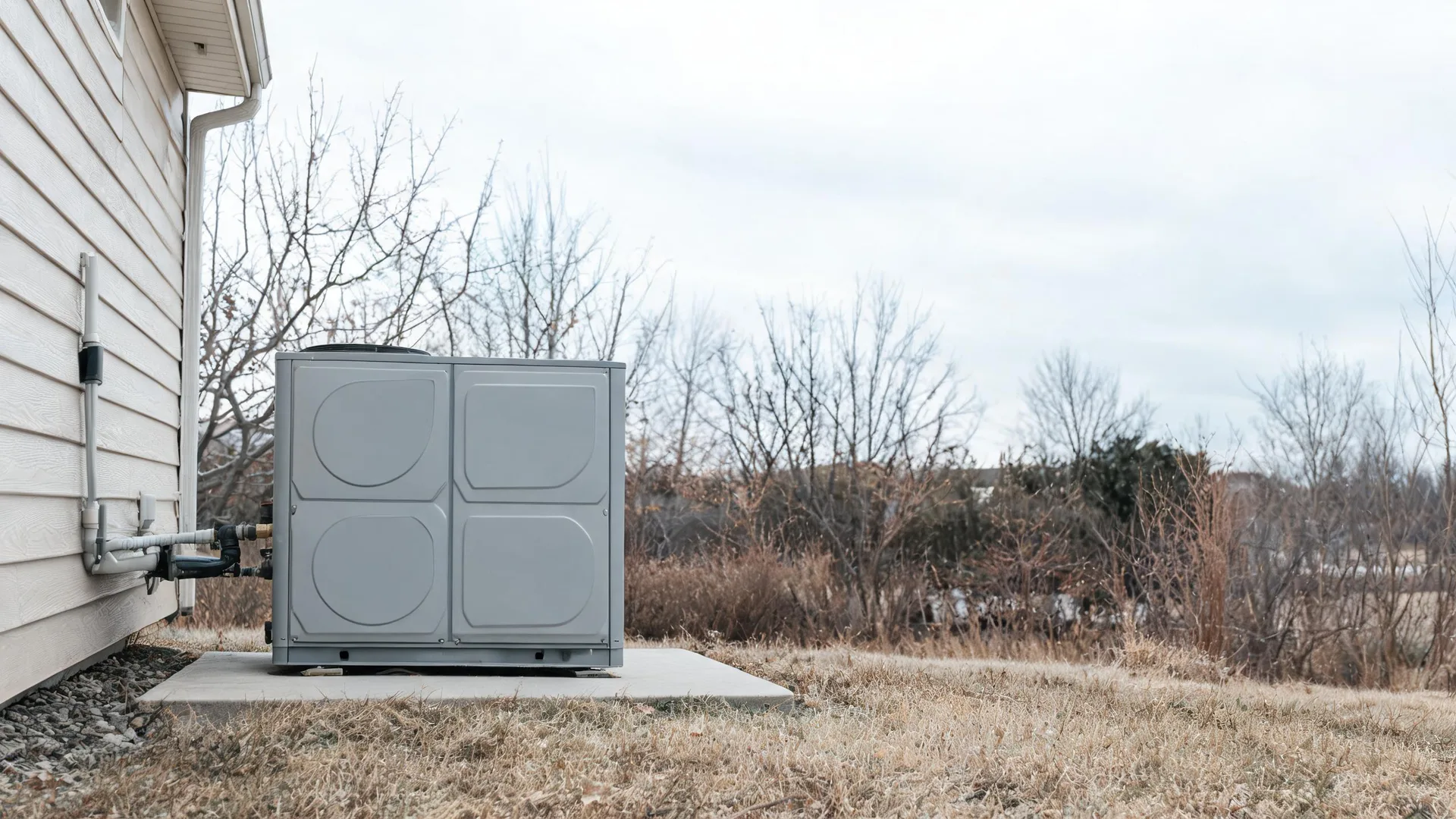
A gray heat pump outdoor unit mounted on a concrete pad next to the stone-accented exterior wall of a house.

What a heat pump tells you before it fails outright

A heat pump runs in both directions, so it carries a heavier load than a furnace or an AC ever does alone. That shows up as wear in specific places. Listen for a clicking reversing valve that won't throw, or a unit stuck in one mode when the thermostat is asking for the other. Watch the outdoor coil for a layer of frost that doesn't clear on its own between cycles, that's usually the defrost control or a sensor failing, not just cold weather. Short cycling, where the unit kicks on and off every few minutes instead of running a full cycle, points to a failing capacitor or a thermostat losing communication with the outdoor unit. Warm air blowing when it should be hot, or cool air when it should be cold, often means the reversing valve is stuck partway. None of these mean the compressor is going. They mean a part did what parts eventually do, which is wear out on its own schedule.

A weak part strains the parts around it

A reversing valve stuck halfway makes the compressor push refrigerant in both directions at once instead of one. A dirty outdoor coil makes the compressor run longer to move the same heat. Left alone, the part that was struggling in the first place stops being the only one taking damage.
Running it anyway can turn a part into a system

A failing capacitor still lets the unit start most of the time, so it's tempting to let it ride. Every hard start it causes puts load on the compressor windings. A fixable part ignored long enough can take the compressor down with it, and that's a different repair entirely.

Most heat pump failures trace back to the same handful of parts, and the compressor usually isn't one of them. Capacitors wear out from the heat and vibration of daily cycling, nothing dramatic, just a part that's done its job too many times. Reversing valves stick when they sit in one position too long between seasons, so the switch to heating is often when a weak one finally shows itself. Defrost sensors and control boards fail quietly, and you don't notice until frost builds up on the outdoor coil and stays there. Contactors pit and burn from the arcing of normal switching, until one day they don't close at all. Each of these is a part with a job, doing that job until it can't, and replacing one doesn't say anything about the rest of the system.

A diagnostic visit starts outside, at the unit itself. A tech checks refrigerant pressures on both the high and low side, because a heat pump running low tells a different story depending on whether it's stuck in heating or cooling mode. They'll check the capacitor's output against what it's rated for, since a capacitor can be weak enough to cause problems long before it fails outright. The reversing valve gets tested directly, usually by energizing it and listening for it to throw, because a valve that's stuck partway won't always show up as an obvious symptom. Electrical connections get checked for pitting or looseness, especially at the contactor, since burnt contacts can cause intermittent failures that are hard to catch any other way. The point of all this is narrowing down which part is actually failing, rather than guessing from the symptom alone.