Two white Southern-style homes with wraparound porches lit by landscape lighting at night, flanked by live oak trees hung with Spanish moss.

Heat Pump Repair in Laurel, MS

Tell us about the job

Takes about a minute. No obligation.

RepairHeat PumpJones County, MS
Step 1 of 2

What ZIP code is the job in?

It's blowing cold air in heating mode

A heat pump that runs but never feels warm at the vents is often stuck in defrost or has lost refrigerant charge. A failed reversing valve can also leave it stuck cooling no matter what the thermostat says. This is not something to wait out, since the system will keep running without actually heating the house.


The outdoor unit is frosted over or frozen solid

Some frost in cold weather is normal, and the unit should run a defrost cycle to clear it. If ice is building up and staying, the defrost board, sensor, or fan motor likely isn't doing its job. Running a frozen unit for long can damage the compressor, so this is worth having looked at before it gets worse.

5 months
November through March, your system heats
6 months
May through October, it cools
39°F
the average winter night it heats against
91°F
the average summer afternoon it cools against
Isometric cutaway illustration of a small house showing interior ductwork and an air handler connected by lines to an outdoor condenser unit on a pad beside the building.
Your system heats November through March and cools May through October.

NOAA nClimDiv, 1991–2020 normals

Jones County took damaging wind 160 times between 2015 and 2024.

A heat pump out here takes more punishment than the national average, and that catches up with worn parts sooner.

Half these homes are older, but age isn't what wears out a heat pump here

Half the homes here were built by 1981
160 damaging wind events from 2015 to 2024
Power costs 13.39 cents a kWh statewide
October is when a weak part gets foundHeat runs here November through March, and the first cold snap finds what didn't survive summer.

A tech usually starts outside at the condenser. They want to see how the fan is spinning and whether the coil is clean or caked with debris. Gauges go on the lines next to check refrigerant pressure, since a unit low on charge will run fine but heat or cool poorly. Inside, they check the reversing valve and the defrost board, since a fault in either one can leave the system stuck in the wrong mode. They also test the capacitor and the contactor, since a weak one of those can make a unit short cycle or fail to start at all. By the end, they can usually point to the one part causing the problem instead of swapping parts to see what helps.

Have the worn part found, not guessed at

That wind damage adds up on a heat pump faster than it would somewhere calmer. The parts that take the beating, the fan motor, the board, the contactor, don't always fail clean. A proper diagnosis finds the one actually causing trouble instead of replacing parts to see what helps.

Find a contractor
A man in a cap, dark long-sleeved shirt and brown work pants, seen from behind, carries a worn leather tool bag up porch steps toward a blue front door beside a blue planter with a shrub.
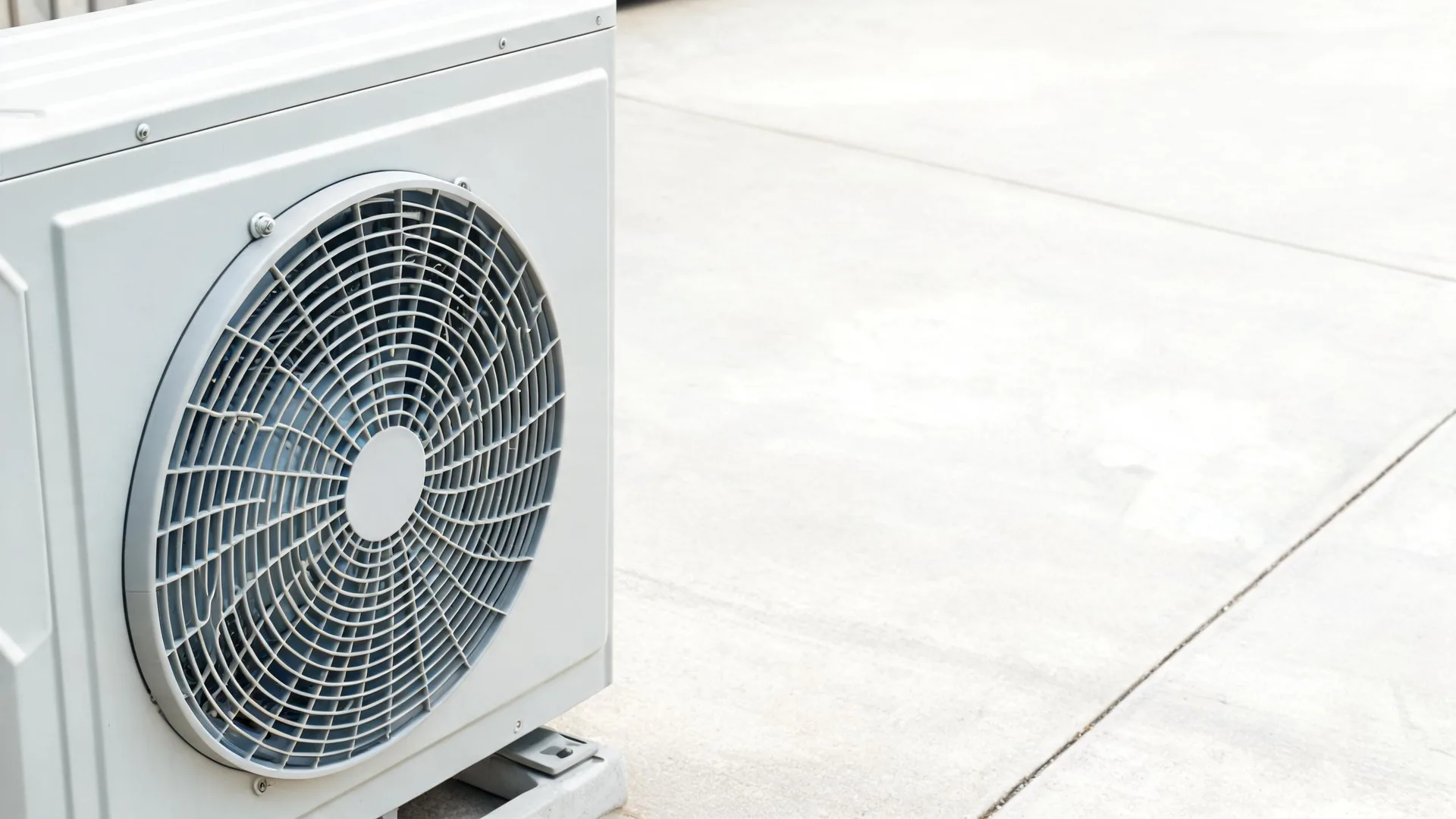
A gray heat pump condenser unit mounted on a concrete pad against the gray lap-siding exterior wall of a house.

It's not age, it's hours

A heat pump works year round, not just one season, and that's what wears it down. The outdoor fan motor runs constant hours keeping air moving across the coil, and motors with bearings wear out from simple runtime. The reversing valve shifts the system between heating and cooling every time the mode changes, and over many cycles the valve can stick or fail to seat right. The defrost board and sensor cycle the unit in and out of defrost all winter, and a sensor that drifts or a board with a failed relay will leave frost built up instead of clearing it. The capacitor that kicks the compressor and fan on weakens gradually, so starts get harder before they stop altogether. None of these fail from one bad day. They fail from doing the same job over and over until something gives.

What you can check before anyone shows up

Check the thermostat is set to heat and the temperature is actually set above room temp. Look at the air filter and swap it if it's clogged, since restricted airflow can make a heat pump seem like it's failing. Walk outside and look at the unit itself. Clear away leaves, mulch or anything piled against the cabinet, since blocked airflow across the coil will cause problems that look electrical but aren't. Check that the outdoor fan is actually spinning when the system is running.

What to leave alone

Don't chip or pry at ice on the coil. It can bend the fins or puncture a line, and either one turns a repair into a bigger one. Don't keep flipping the breaker if it trips more than once, since that usually means a short or a locked motor, and running it again can damage the compressor. Don't pour water on a frozen unit to melt it faster. Switch the thermostat to emergency heat if that option exists, and leave the rest to a diagnosis.

A heat pump that's struggling doesn't fail faster just because it's still running. It fails faster because it keeps trying to do a job it can't finish. A compressor working against low refrigerant charge runs hotter than it should, and heat is what shortens a compressor's life. A unit stuck in defrost mode cycles the reversing valve back and forth without ever settling into one job, and that's wear the valve wasn't built for. Ice left to build on a frozen coil blocks airflow completely, so the system draws in a cold coil with no air moving across it, which is exactly the condition that kills compressors. None of this shows up as a bigger problem right away. It shows up later, as a part that was marginal now failing outright, because it never got the chance to rest.

A repair makes sense when the part causing trouble is isolated and the rest of the system is sound. A bad capacitor, a stuck reversing valve, a failed defrost sensor, these are single points of failure, and swapping the one part gets the unit back to working like it did before. Replacement starts to make more sense when the compressor itself is the problem, since that's the most expensive part in the unit and the one most likely to take other components down with it when it goes. It also makes sense when the same unit keeps coming back for different failures, because that pattern usually means the whole system is wearing out at once rather than one part having a bad day. Age matters less than what's actually failing and how often it's failing. A unit that's given reliable service and now has one clear fault is usually worth fixing. A unit that needs something different fixed every season is telling you it's done being reliable.