






Night view of illuminated white Southern-style houses with wraparound porches beneath Spanish moss-draped oak trees.

Heat Pump Repair in Greenwood, MS

Tell us about the job

Takes about a minute. No obligation.

RepairHeat PumpLeflore County, MS
Step 1 of 2

What ZIP code is the job in?

May is when a weak heat pump shows its hand in Greenwood. The system has sat idle since March, and the first real heat load finds whatever was already marginal, a contactor pitted from last year or a capacitor that tested weak but kept limping along. October works the same way for heat, right before November load hits a part that's been resting for months. If your heat pump is struggling in the first few weeks of a run, that's not bad luck. It's the weak point finally getting tested.

5 months
November through March, your system heats
5 months
May through September, it cools
37°F
the average winter night it heats against
91°F
the average summer afternoon it cools against
Isometric cutaway illustration of a single-story house showing interior rooms with furniture, an attic duct system connected to an indoor air handler, and an outdoor condenser unit linked by lines along the exterior wall.
Your system heats November through March and cools May through September.

NOAA nClimDiv, 1991–2020 normals

Leflore County logged 44 severe weather events between 2015 and 2024, most of them wind.

A heat pump that trips during a storm usually just needs a reset, not a new part.

Half the homes here are old enough that their heat pump may be on its last stretch

Half the homes here were built by 1973
Power costs 13.39 cents a kWh statewide
Climate zone 3A

Before paying for a repair, ask how old the heat pump actually is, not just the house. A unit installed when an older home was built has long outlived any normal lifespan. One installed five years ago hasn't, even if the house itself is older. If the problem is a weak contactor or a capacitor, that's a small fix regardless of the unit's age. If it's the compressor, the age of the system changes the math on whether to fix it or replace it. A straight answer on age settles which conversation you're having.

Get it looked at early

Problems tend to show up in the first weeks of the season, when the load hits a part that was already weak.

Find a contractor
A man in a dark shirt and tan pants carries a canvas tool bag as he walks up concrete steps toward a blue front door on a porch with a potted shrub.
A gray heat pump outdoor unit mounted on a concrete pad next to the stone-accented exterior wall of a house.

Running it while it struggles doesn't buy you time

A heat pump that's struggling doesn't fix itself by staying on. It cycles harder to chase the setpoint, and whatever's marginal gets worked harder too. A weak capacitor loses more of its charge with every start. A pitted contactor arcs a little more each time it closes, until it sticks or fails to close at all. A compressor low on refrigerant runs hotter than it should, and heat is what kills a compressor over time. None of that reverses when you turn the thermostat down for a while. The part that's wearing out keeps wearing out, just slower. What starts as a system that runs long and struggles to keep up can end as a system that doesn't start at all, and the fix on the far side of that is a different conversation than the one you'd have today.

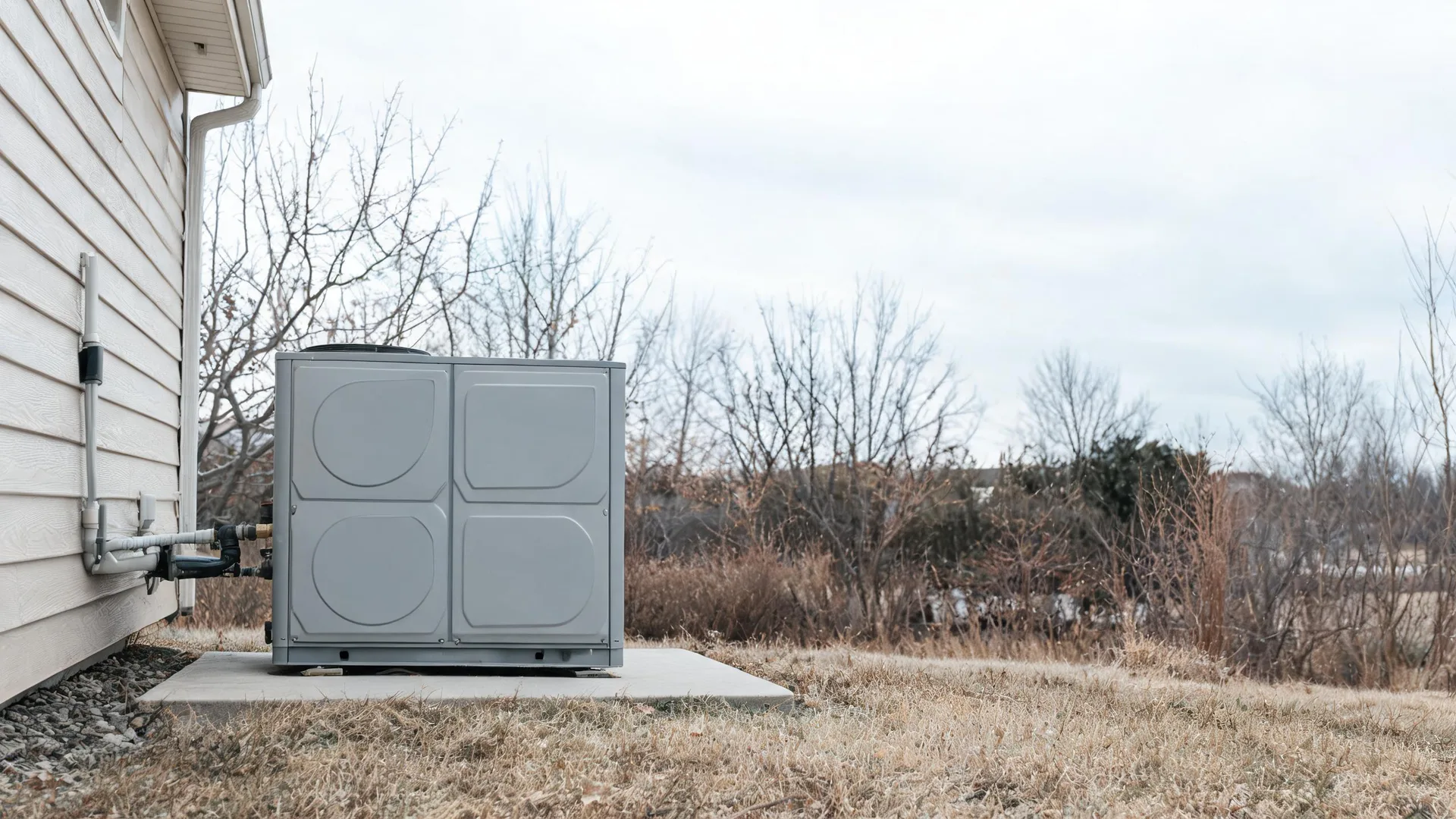
The reversing valve is the part unique to this machine

A heat pump has one part a furnace or straight AC doesn't have. The reversing valve is what switches it between heating and cooling. When it sticks, the system can get stuck in one mode no matter what the thermostat asks for, or it blows air that's not as warm or cool as it should be. A valve that's starting to fail often makes a clunk or a hiss when it tries to switch.
Most other failures are the same ones any system has

Outside the reversing valve, a heat pump wears out the way any compressor-driven system does. Contactors pit from arcing every time they close. Capacitors weaken and lose a little more charge with each start. Refrigerant leaks out slowly at a fitting or a coil, and the compressor runs hotter than it should trying to make up for the loss. Any of these shows up the same way, the system runs longer, cycles more, or stops keeping up with the setpoint.

A few things are worth checking before anyone comes out. Make sure the thermostat is actually set to heat or cool as expected, and that the setpoint is past the room temperature. A setting bumped by accident gets mistaken for a broken system more often than you'd think. Look at the outdoor unit for ice built up on the coil, or snow and debris blocking it. Airflow in or out stops the whole system cold either way. Check the filter too, since one that's clogged starves the system of airflow and can leave a heat pump running constantly without ever catching up. If the unit won't start at all, check the breaker before anything else. A tripped breaker looks exactly like a dead system but takes almost no time to rule out. None of this fixes a weak capacitor or a stuck reversing valve, but it clears away the things that aren't actually broken.

A diagnostic visit starts outside, at the unit itself. A tech checks refrigerant pressure on both the high and low side, because a heat pump that's low on charge gives itself away in the numbers before it gives itself away in the air coming out of the vents. From there it's the electrical side, the contactor and capacitor, checked under load rather than just looked at, since a capacitor can look fine sitting still and still be too weak to start the compressor. The reversing valve gets tested in both directions, heating and cooling, to see whether it actually switches clean or hangs up partway. Airflow gets checked too, at the filter, the coils, and the blower, because a system that's short on airflow will show symptoms that look electrical or refrigerant-related but aren't. Most of what's wrong shows up in that sequence before anything gets opened up or replaced.