





A red brick wall with a row of low shrubs and mulch bed on the left, a mown lawn in the center, and a single-story light-colored house with a gabled roof beyond, backed by pine trees under an overcast sky.

Heat Pump Repair in Columbus, MS

Tell us about the job

Takes about a minute. No obligation.

RepairHeat PumpLowndes County, MS
Step 1 of 2

What ZIP code is the job in?

Before you call anyone, check the thermostat is set to heat and the temperature is actually above room temperature. Go outside and look at the outdoor unit. If it's caked in ice or snow, that can be normal during a defrost cycle, but if it stays iced over for hours, something is wrong. Check that the outdoor fan is spinning and air is moving through it, not blocked by leaves or a cover. Inside, pull the filter and hold it up to a light. If you can't see through it, that's choking off airflow and can cause all sorts of problems down the line. Last, check your breaker panel for a tripped breaker before assuming the unit itself has failed.

5 months
November through March, your system heats
5 months
May through September, it cools
35°F
the average winter night it heats against
91°F
the average summer afternoon it cools against
Isometric cutaway illustration of a single-story house showing interior rooms, attic ductwork and an air handler, with an outdoor condenser unit connected by lines along the exterior wall.
Your system heats November through March and cools May through September.

NOAA nClimDiv, 1991–2020 normals

A heat pump that runs nonstop but never gets the house warm is losing somewhere in the system.

A low refrigerant charge or a failing compressor both show up this way, and running the unit hard while that goes unfixed only adds wear.

Half the heat pumps in Columbus are younger than you'd think

Half the homes here were built by 1981
110 damaging wind events from 2015 to 2024
Power costs 13.39 cents a kWh statewide

October matters here. Heat starts up in November, and a heat pump that sat unused since March will show you its weak point fast once it has to work. A reversing valve that was sticking back then often won't move at all once the weather turns. If your system struggled at the start of last winter, the same part is still in there, and sitting idle all summer doesn't fix it. Getting it checked in October, before the first cold night, means finding out now instead of on the morning you need the heat most.

Repair it

If your system came with a newer house, it likely has plenty of life left. Repair is usually the right call.

Find a contractor
A man in a dark shirt, tan pants and a cap carries a canvas tool bag up wooden porch steps toward a blue front door, with a potted shrub beside the entry.
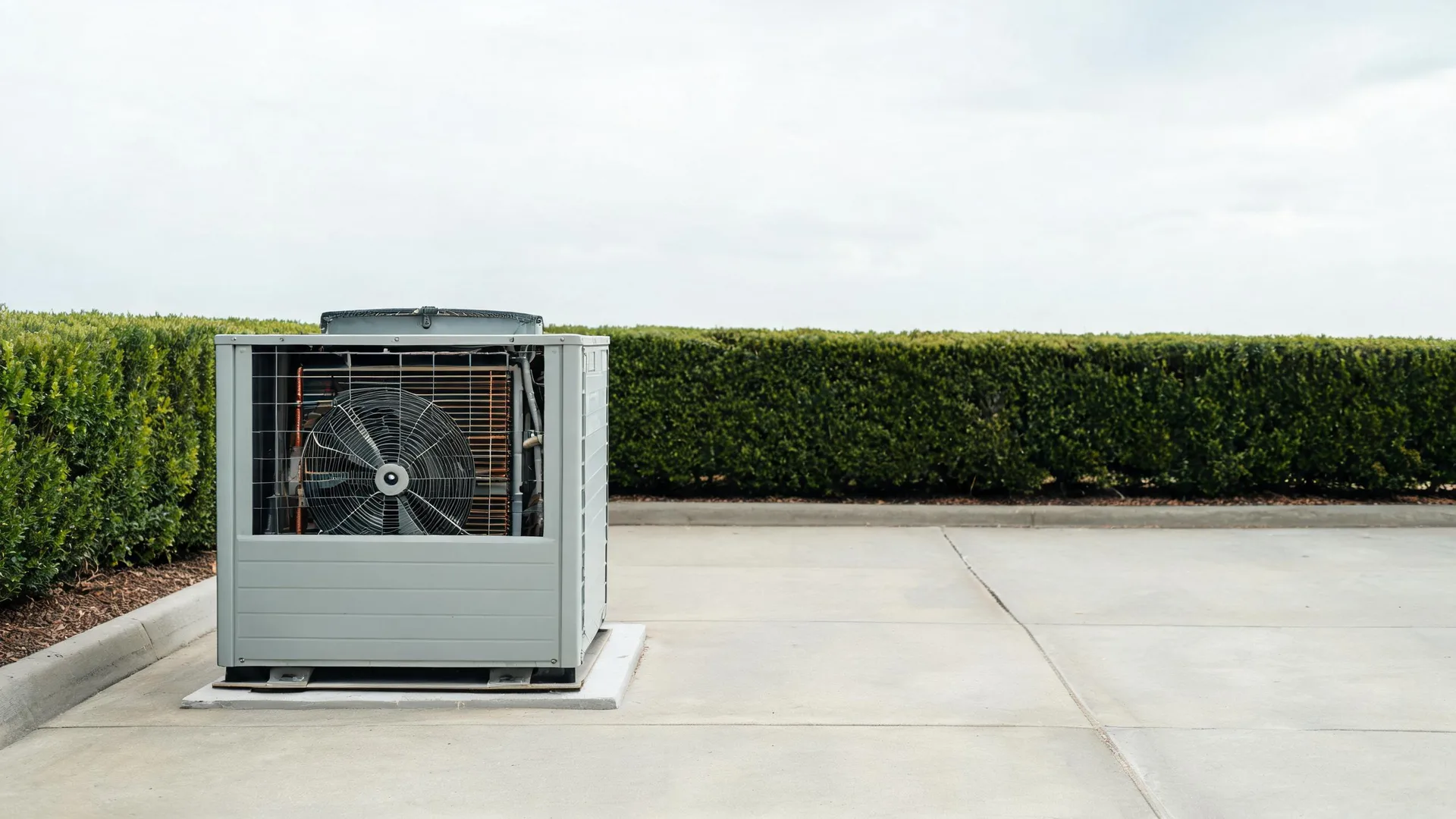
A gray heat pump outdoor unit mounted on a concrete pad next to the stone-accented exterior wall of a house.

Every call starts with the same question. Where is it losing ground

A tech working a heat pump complaint starts outside at the unit. Gauges go on the service ports to check refrigerant pressure. Low charge shows up as poor heating and a compressor working harder than it should to keep up. From there it's the reversing valve, the part that switches the system between heating and cooling. A valve that's stuck or not shifting fully gets found by checking line temperatures on both sides of it. Inside, the tech checks the air handler for a failing blower motor or a dirty coil. Either one cuts the airflow the whole system depends on. Electrical checks come next. Contactors, capacitors, the defrect board, anything pitted, swollen or reading outside spec. A lot of what shortens a heat pump's life traces back to short cycling, the unit kicking on and off instead of running a full cycle. That happens when a part is already struggling and the system can't keep up.

The reversing valve wears from the switching itself

Every time a heat pump changes between heating and cooling, the reversing valve shifts to redirect refrigerant flow. That shift is a mechanical move, and over years of switching back and forth, the valve can start sticking in one position or stop sealing fully. A valve that doesn't seat right lets refrigerant bypass where it shouldn't, and the system runs without doing its job properly.
Short cycling is a cause as much as a symptom

A heat pump that starts, runs briefly and shuts off again never gets to run an efficient cycle. Short cycling puts extra wear on the compressor and the contactor with every restart, and a part that's already weak makes the cycling worse, which wears the rest of the system faster. Once that pattern sets in, it tends to feed itself until something fails outright.

A compressor that's struggling doesn't fail quietly. If it's low on charge or working against a bad valve, it draws down harder on the start to keep up, and that extra strain is what burns through a motor winding or a bearing before its time. The same goes for a blower motor pushing against a clogged coil. It runs hotter than it was built to, and heat is what wears a motor out. None of this fixes itself by giving it time. A system that's struggling and left running is just getting more hours of wear on the part that's already going, and when it finally quits, it's often not the only thing that needs replacing.

A heat pump repair is rarely a hard call once you know the part that's failing. A reversing valve, a contactor, a capacitor, a blower motor, these are straightforward swaps and the rest of the system is usually fine once they're replaced. The compressor is different. It's the most expensive part in the unit, and if a tech tells you it's going, that changes the math, because a compressor replacement can cost close to a new system without any of the warranty or efficiency that comes with one. Age matters alongside that. A system nearing the end of its expected life that needs a major part is a different decision than a younger one with the same failure. Ask what's actually failing and what it would take to fix it before deciding anything.