






A white Southern-style house with a wraparound porch photographed at night, surrounded by Spanish moss-draped oak trees lit by landscape lights.

Heat Pump Installation in Pascagoula, MS

Tell us about the job

Takes about a minute. No obligation.

New system or replacementHeat PumpJackson County, MS
Step 1 of 2

What ZIP code is the job in?

A heat pump has to be sized to the house, not picked off a shelf. Too big and it short cycles, blasting the space with heat or cold air and shutting off before it pulls the moisture out of the air, which leaves rooms feeling clammy even when the temperature looks right. Too small and it runs flat out on the hottest and coldest days and still can't keep up. Sizing it right means a contractor works through the actual heat gain and heat loss of the house, looking at window area, insulation, ceiling height, and which way rooms face, then matches that load to equipment that can cover it without oversizing. Ductwork matters too. A unit sized correctly for the house but paired with ducts that are too small or too leaky still won't deliver the comfort it's rated for.

5 months
November through March, your system heats
7 months
April through October, it cools
42°F
the average winter night it heats against
90°F
the average summer afternoon it cools against
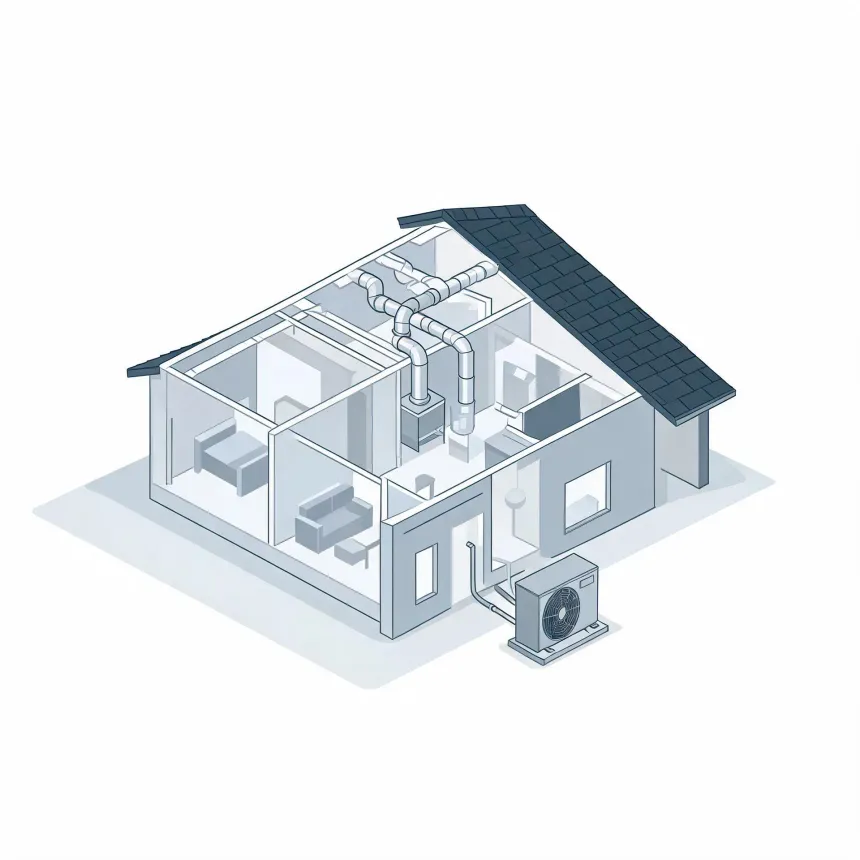
Isometric line illustration of a cutaway house showing interior rooms with furniture, ceiling ductwork connected to an indoor air handler, and an outdoor condenser unit linked by refrigerant lines.
Your system heats November through March and cools April through October.

NOAA nClimDiv, 1991–2020 normals

Electricity heats 81.3% of homes in Jackson County.

A heat pump replacing electric heat drops into a house already wired for it.

Get it in before April, and again before November

Cooling runs April through October
Heat runs November through March
Power costs 13.39 cents a kWh statewide
Built for PascagoulaElectricity here runs 13.39 cents a kilowatt-hour, so what matters most is a system that keeps running when the power doesn't

Jackson County sits in climate zone 2A, a hot and humid zone where cooling carries most of the load over the year. Any split-system heat pump installed here has to meet 14.3 SEER2 for cooling and 7.5 HSPF2 for heating, the federal minimum for equipment made from 2023 on. That floor is set for the whole country, not just this region. Straight air conditioners installed in the Southeast have to clear a higher bar, but heat pumps follow the national number either way. These are minimums, not a ceiling, so higher-efficiency units are on the table too. A federal tax credit is available for qualifying heat pump installations, worth checking against what a contractor proposes before deciding on equipment.

Plan for storms

Storms and outages are common here. Plan where the outdoor unit goes, how it's protected, and how you'll keep heat and hot water in an outage.

Find a contractor
A man in a dark jacket, cap and tan work pants climbs steps toward a blue front door, carrying a canvas tool bag with tools in its side pockets, beside a shrub in a blue planter.
A residential heat pump outdoor unit mounted on a concrete pad next to a house with gray vinyl siding.

What you pay once runs for years

Installation price mostly comes down to how much has to change beyond the equipment itself. A straight swap, same spot for the outdoor unit, same spot for the air handler, ductwork already sized right, costs less because there's less to touch. Add a line set that has to run further, an electrical panel that needs upgrading to handle the new load, or ductwork that has to be resized or sealed, and the job grows. The unit itself varies too. Higher-efficiency equipment and variable-speed compressors cost more up front than single-stage units. None of that is padding. A heat pump sized and installed right should run for many years with regular filter changes and an annual check of the refrigerant charge and the coils, so what's spent at install time is what the system runs on for its whole life.

Ask what stage the compressor runs

A single-stage heat pump is either on at full output or off. A variable-speed compressor can throttle down and run longer at lower output, which holds a steadier temperature and pulls more moisture out of the air. Ask which kind is being quoted and why that fits the house, not just what's in stock.
Ask how the system handles the coldest nights

Every heat pump reaches a point where outdoor air is too cold to pull heat from efficiently, and backup heat has to take over. Ask what the backup source is and how the system decides when to switch to it. A contractor who can answer that has actually worked through the equipment, not just priced it.

Whoever installs the new heat pump still has to deal with what's already out there. If the house had a straight air conditioner before, there's an outdoor condenser, a coil, and usually a furnace or air handler tied into the same ducts. Refrigerant has to be recovered from the old system before any of it comes apart. That's not optional. Venting it to the air is illegal, and any contractor pulling a permit has to show the refrigerant was recovered properly. After that the old outdoor unit, the indoor coil, and the air handler or furnace all get disconnected and hauled off. If the line set is being reused, it gets flushed out so oil and debris from the old system don't contaminate the new one. If it's old or the wrong size for the new equipment, it gets replaced instead. None of this is the part of the job anyone looks forward to, but skipping steps here is how a new system ends up running on contaminated refrigerant or undersized lines from day one.

Install day starts with the old equipment coming out and the new pieces going in, and most of the day is spent on connections rather than the units themselves. The outdoor unit gets set on a pad or bracket, leveled so the compressor inside isn't straining at an angle. The line set gets run between outdoor and indoor units, connected, then pressure tested to make sure there are no leaks before any refrigerant goes in. The system gets evacuated with a vacuum pump to pull out air and moisture, because either one left in the lines will damage the compressor over time. Only after that does refrigerant get weighed in to the charge the equipment calls for. Electrical hookup, a dedicated circuit sized to the unit, has to happen before anything is powered on. Once it's running, a contractor checks airflow at the vents, checks the temperature split between the air going in and the air coming out, and confirms the thermostat is controlling the system the way it's supposed to.